Thank you for that kind introduction.
Let me tell you about a session in a course I am co-teaching this quarter at the Stanford Graduate School of Business.
Last month we had Jeff Maggioncalda, Coursera's CEO, as a guest presenter. And he told the students that an engineer on his team had sent him a screencast of an AI taking an entire Coursera course. Watching the videos. Responding to all the questions. Submitting comments to the discussion board. Doing problem sets. And the AI aced the course.
Last year AI showed it could pass standardized tests, starting with admissions exams and later board licensure exams.
Much of the initial response from education was, uh oh. We are going to need better exam security. More proctoring. More blocking.
Now this year AI can take the whole course. One of the students asked, "So what does this mean for Coursera?" Jeff shrugged as if to say, "I have no idea". The next day he stepped down from his job. True story.
The race between education and technology is a framework developed by the Nobel Prize winning economist Claudia Goldin, and her Harvard colleague Lawrence Katz. It describes how education has helped humans stay ahead of obsolescence and avoid technological unemployment by continually improving their productivity.
In the 19th century the power loom threatened manual labor in the textile industry. We responded by investing in humans' capabilities to utilize machines, rather than be displaced by them.
This framework explains American investments in ever-higher levels of education, successively establishing the world's first systems for universal elementary education, high school education, and then higher education. Each was a response to a wave of technological advances, from the Industrial Revolution through the 20th century knowledge economy.
In the past two years technology has obviously taken a leap forward, in the form of generative AI, and there is a new threat of obsolescence.
Education needs to respond, and this talk is about what that response should be.
Part of what's exciting and interesting about this current wave of technological advances is that the very technologies that pose a threat, can also be deployed by education. That wasn't true of the power loom.
But just putting general purpose AI in classrooms is unlikely to be effective. In fact there is research that shows that it can demoralize students and reduce their learning.
What we need is a thoughtful, educationally sound approach based on learning science.
I am going to offer some ideas for how we can do that.
Before we get there, though, let's take a step back with some historical context.
The basis for our higher education system is the idea of human capital.
The concept of human capital arose in the 1950s and '60s when economists were mapping the relationship between education and economic development.
They studied "years of schooling" and correlated this with GDP.
They later realized that skills offered a finer grained and more precise way of thinking about the drivers of economic development.
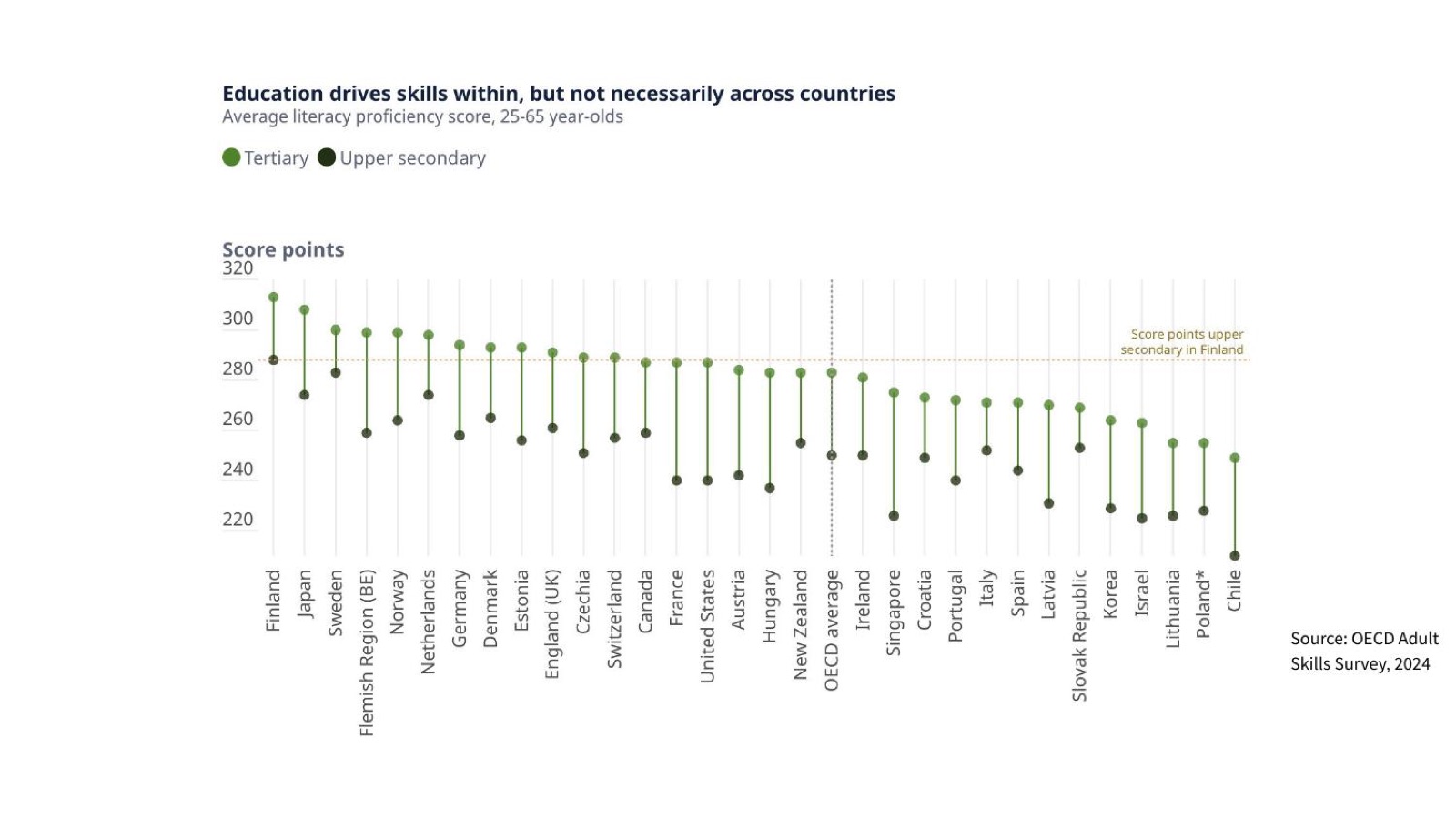
And they developed the idea of human capital, which treats humans as a form of capital like factory equipment or financial capital: A store of value that could be increased with investment. Skills were the source of that value.
Earlier theories had viewed labor in opposition to capital and capitalism.
Human capital, which might have sounded like an oxymoron in an earlier era, was a new approach that viewed humans and capital as compatible.
Developing skills in employees or citizens increased their value. So anything that increased skills was an investment for companies and countries.
In the late nineteenth and 20th century the education system was optimized to aid in the development of human capital.
Remember, humans were in a race with technology – and new skills would allow us to keep up and make productive use of machines and factory equipment.
Skills were placed at the center of educational attainment goals.
We developed assessment systems that sorted people and tracked their skills in numeracy and literacy.
We developed international benchmarks, such as PISA and TIMMS, that compared assessment performance across countries – so now we were racing not just with technology, but with other nations as well.
So when digital learning arose later in the 20th century, the height of the human capital era, of course it maximized individual skills for individual learners.
Let me offer two examples – one from ed tech and one from higher education innovation.
Personalized learning uses algorithms to differentiate instruction at the individual student level, delivering just the right information to the right learner at the right time.
Starting with ELIZA, developed at MIT in the 1960s, followed by advances with "cognitive tutors" at Carnegie Mellon in the late 1990s, personalized learning is based on an analogy to human tutoring.
We know human tutoring is effective. But it's too expensive to provide to every student. So if we can approximate human tutoring with technology, perhaps we can get some of its benefits at a reasonable cost.
This is now the product thesis behind dozens of ed tech startups that are trying to build AI tutor chatbots.
My second example of education-as-human-capital-development is competency-based education, or CBE. CBE is an alternative model for organizing and measuring learning. Instead of semesters and credit hours, which hold time constant and allow learning to be variable, CBE holds learning as a constant and allows time to vary. So a student can take however much time they need to master a concept. Once they can prove their competency via an assessment they move on to the next topic. Graduation happens when mastery is achieved, not on a specific day.
Both of these models – personalized learning and competency based education - were designed to maximize skills at an individual level.
And in fact they had some successes in that. Nursing graduates of Western Governors University, which helped pioneer CBE starting in the late '90s, have some of the highest rates of passing the nursing licensure exam, the NCLEX.
That sounds impressive. Until you consider that that exam is one of those that AI can pass as well.

The AI moment is revealing three interrelated fault lines in the existing system of education-for-human-capital.
I want to go through each of these.
And I will then suggest how we might overcome some of these faults with a new approach.
The first concerns are psychological.
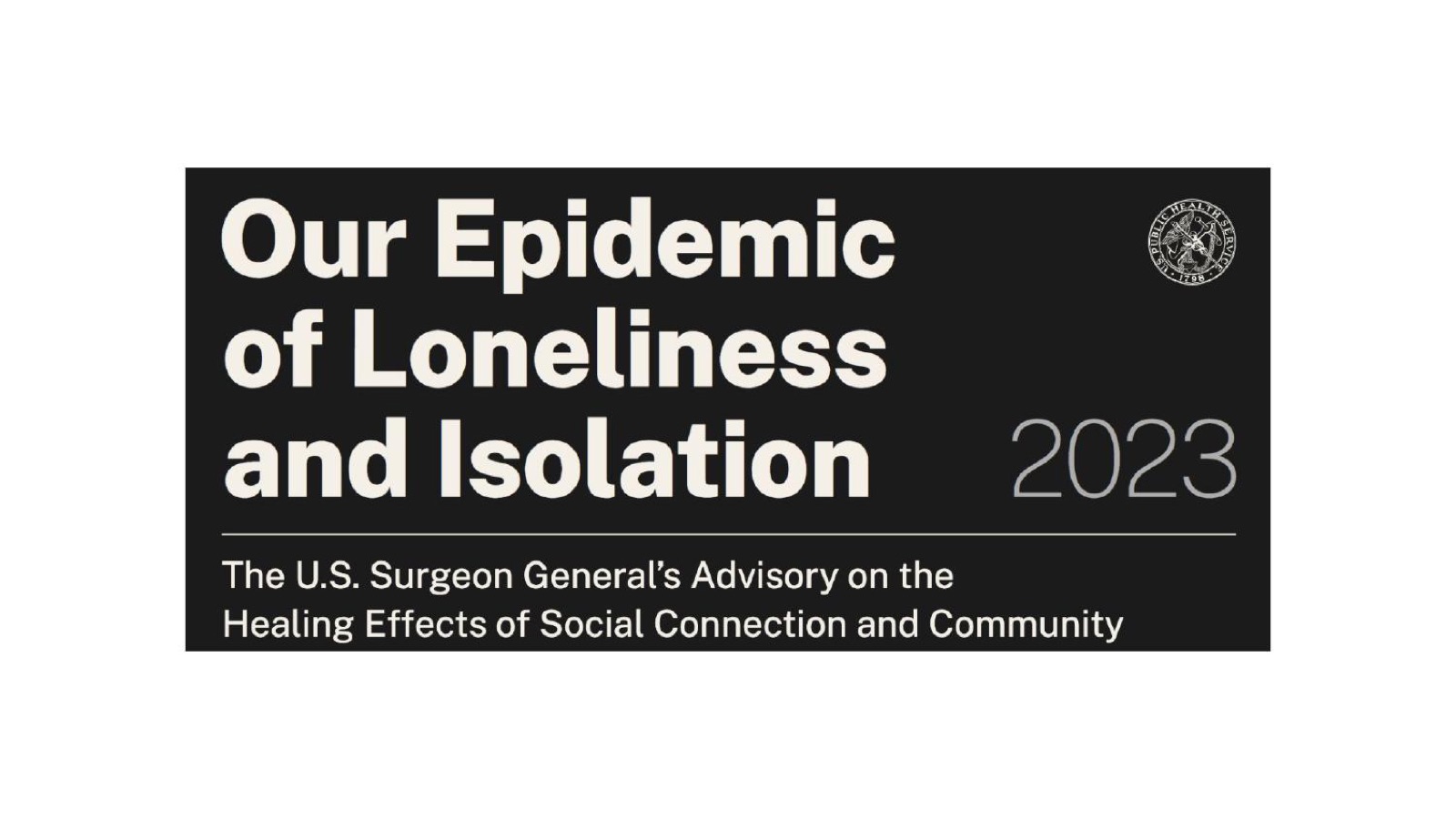
We are facing an epidemic of loneliness and isolation.
This is the headline of a surgeon general report from 2023, which said that "Humans are wired for social connection, but we've become more isolated over time," with profound implications for our health and communities.
Colleges and universities have experienced an extreme version of those implications.
At Stanford, about one third of undergrads are cared for in our psychological support system.
Like other institutions, we have added more therapists, but have been unable to keep up with demand.
I am glad therapeutic services are available to students but health providers would be the first to say that they are just treating the symptoms of a larger malady. When so many students are in professional care, we have to recognize that there is a more fundamental public health challenge of prevention.
When we treat students as individual actors in a competition against their peers, it sets up a zero sum game that harms the learning community.
This is unhealthy, even for the winners of the game, who know their successes came at the expense of others, and are often based on luck. The results are anxiety and "imposter syndrome" for the "winners" and exclusion and resentment for everyone else.
The scholar Daniel Markovits has called this the "meritocracy trap" and he makes a case that it's at the heart of the mental health crisis on campus.
But maybe the issue precedes meritocracy. Maybe it is really about how educational individualism can veer into educational isolationism. And how a theory of human capital can become a competitive game of human capitalism.
Either way, individualized learning, based on maximizing my skills and abilities, so I can get ahead, comes at a steep psychological price.
Now I want to turn to the economic costs of education for human capital.
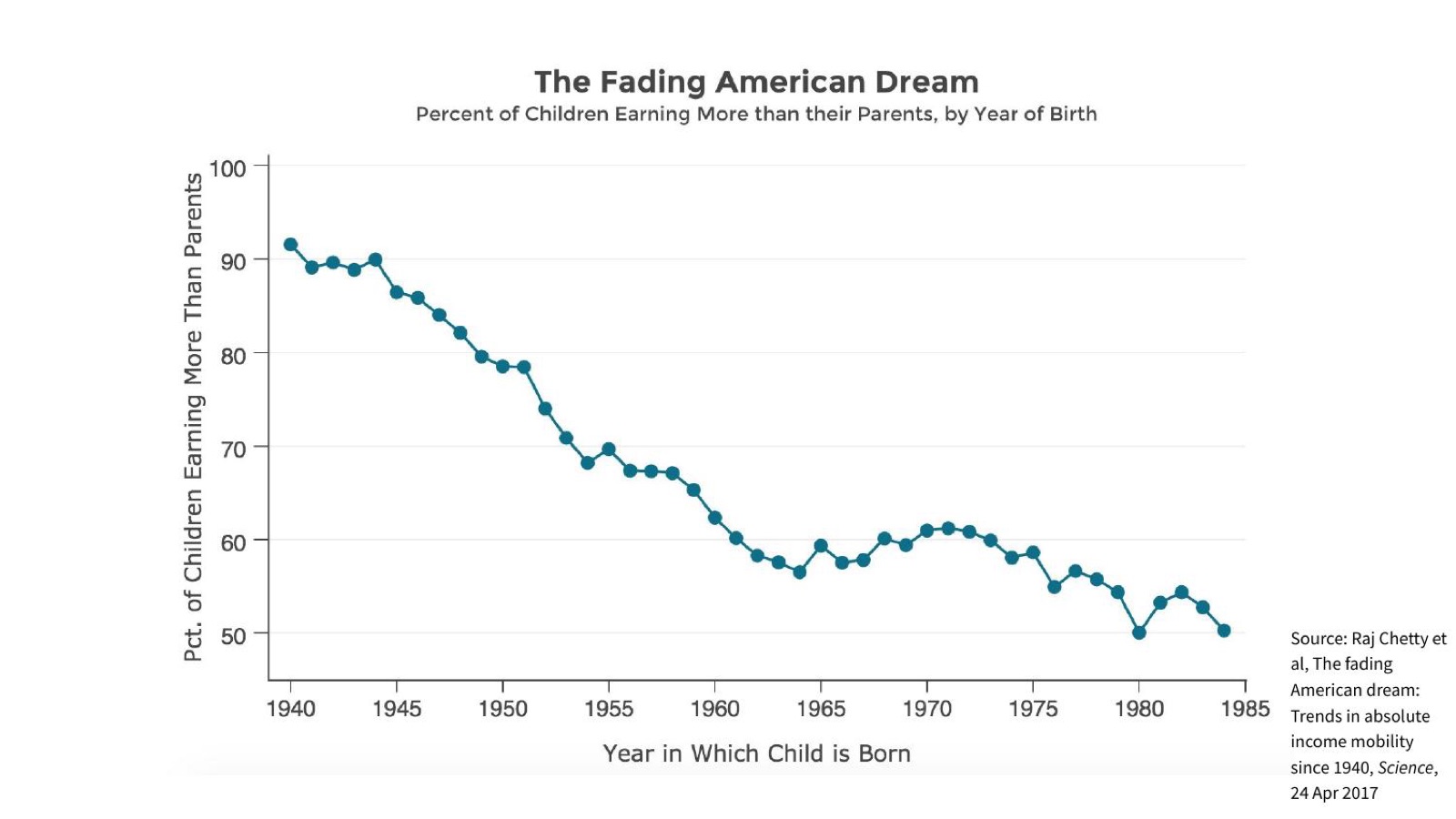
Raj Chetty calls this the fading American dream.
The generation born around 1980 will be the first in American history that does not out-earn its parents in inflation adjusted terms.
At the same time we have greater economic stratification and a level of inequality on par with the Gilded Age.
Given all the investments we've made in skills, how is this possible?
We spend an average of $186k on each student through their K-12 education, and tens or hundreds of thousands more on college and graduate school. This is invested through a combination of public subsidies, savings and debt.
Are those numbers the result of Baumol's cost disease, which predicts that costs will always rise faster in labor intensive fields, such as education, where productivity gains are harder to come by, compared to other industries?
Or are humans unable to keep up in the race between education and technology?
Or is there something else going on?
Let me leave that question there for a moment and turn our attention to the political costs of human capital.
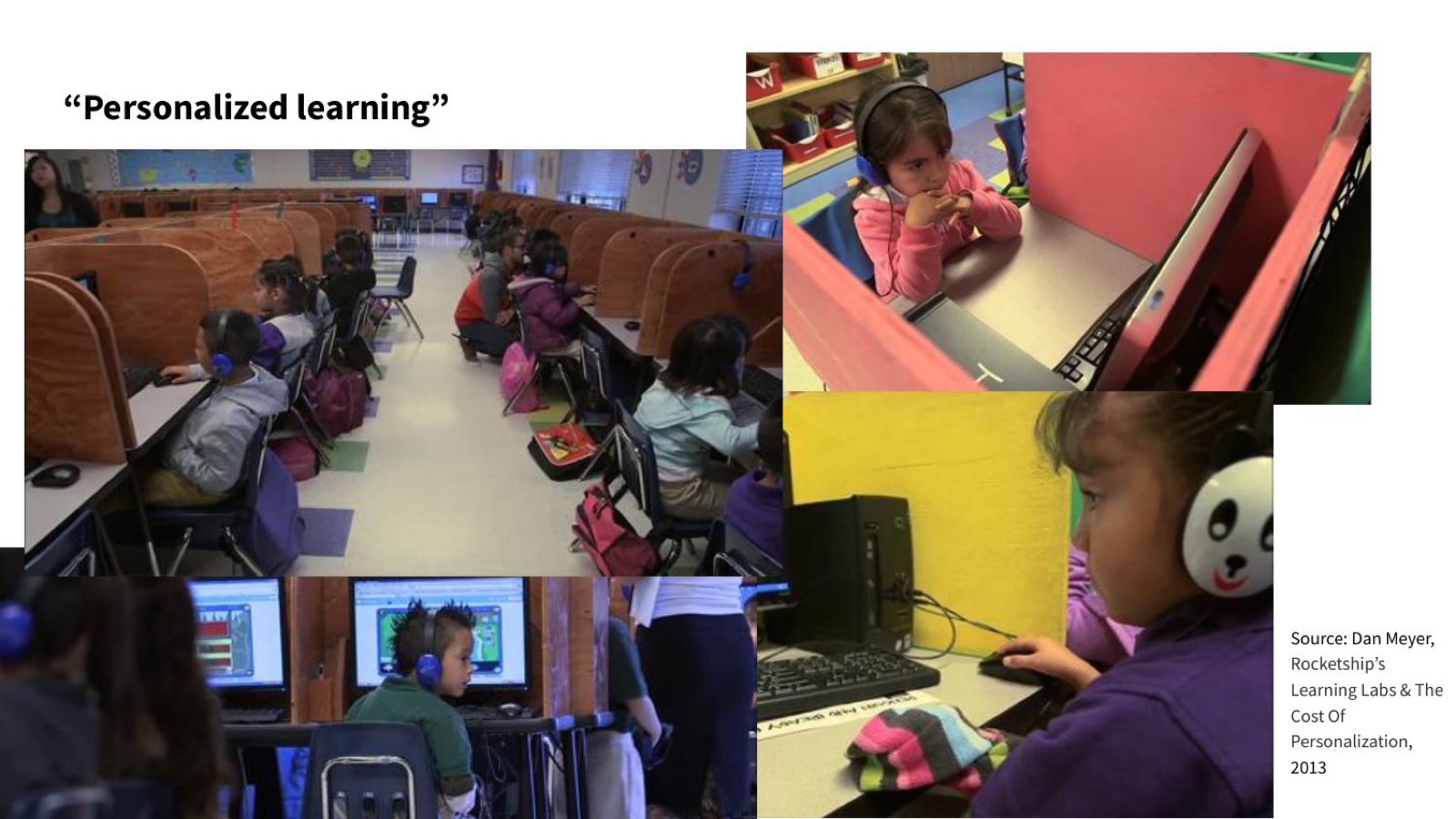
I don't need to tell you that we are living in an age of political polarization.
Much of this is driven by our media culture and the splintering of information into ideological echo chambers.
If you are concerned about echo chambers, doesn't an image like this give you pause?
Each of us now spends two more hours on screens per day than we did a generation ago. All screens, from big to small.
Classroom time is finite, a scarce resource. Every moment a child spends with headphones on in front of a screen is a moment they are not listening to their classmates or teacher. Learning how to listen.
The result may contribute to an inability to listen to those who have different perspectives.
To be clear, I'm not blaming the education system, and certainly not the online education system, for these problems. Education is part of a larger human capital movement that directed the goals.
But I would argue that we in education have not done enough to offer an alternative vision that goes beyond individuals and their skills, to address whole learners and communities. Our job as educators isn't simply to give learners what they want and are willing to pay for.
The stakes are higher than that. What we do shapes citizens, our economy, and our country.
Even economists of human capital are starting to recognize this. David Deming and Mikko Silliman are proposing to redefine human capital:
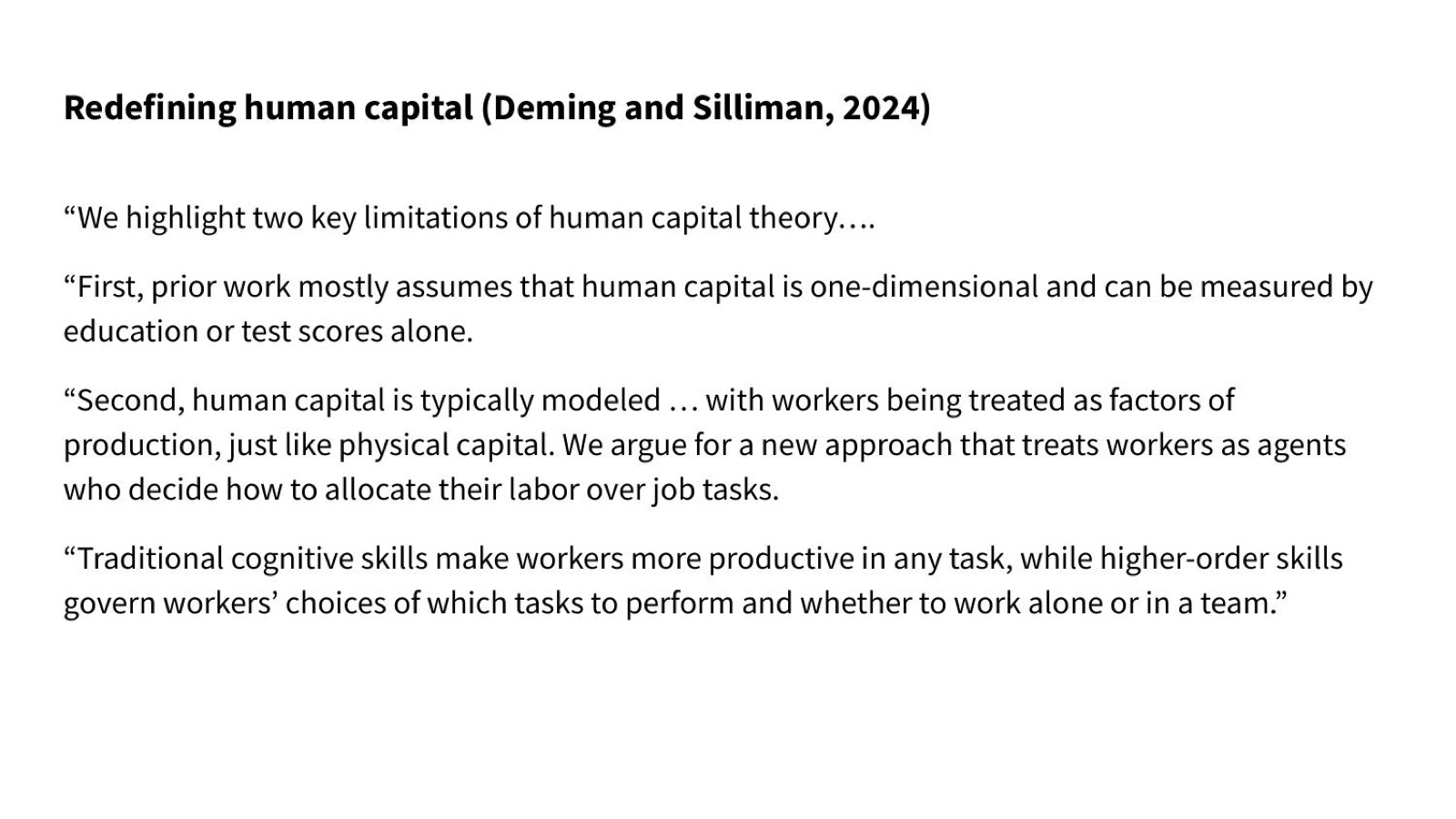
This was motivated by a reckoning with the impact of AI on productivity and human work.
And there needs to be a similar redefinition of the goals of higher education, based on an awareness of the limitations of the human capital model in the age of AI.
In the next part of this talk I want to make the case that social capital should be the primary goal of online higher education.
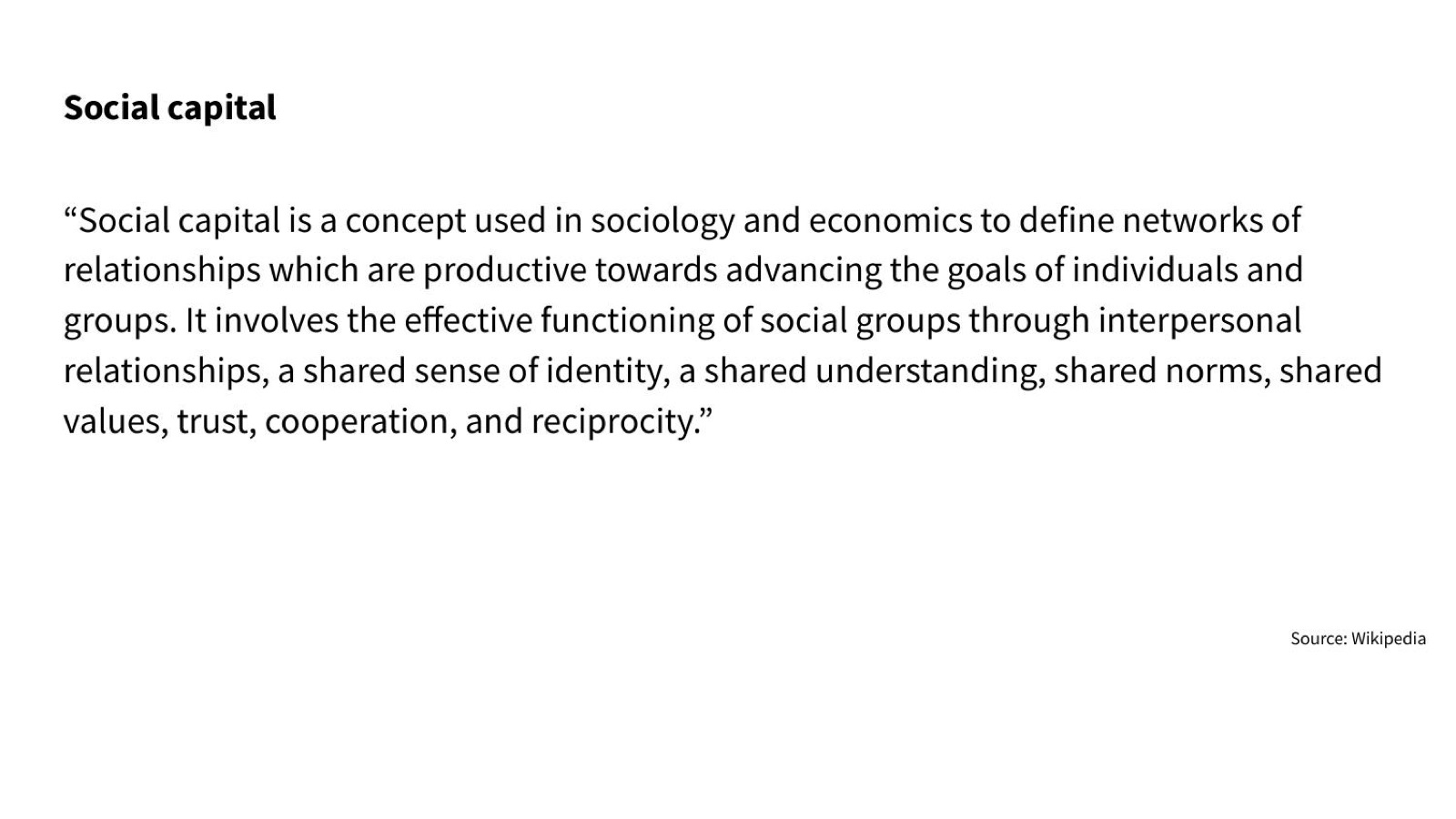
For each of the concerns I raised about human capital, social capital offers an alternative.
Psychological:
Social capital is an indicator of the health of human networks and communities.
Yet paradoxically the health benefits for us as individuals are immense.
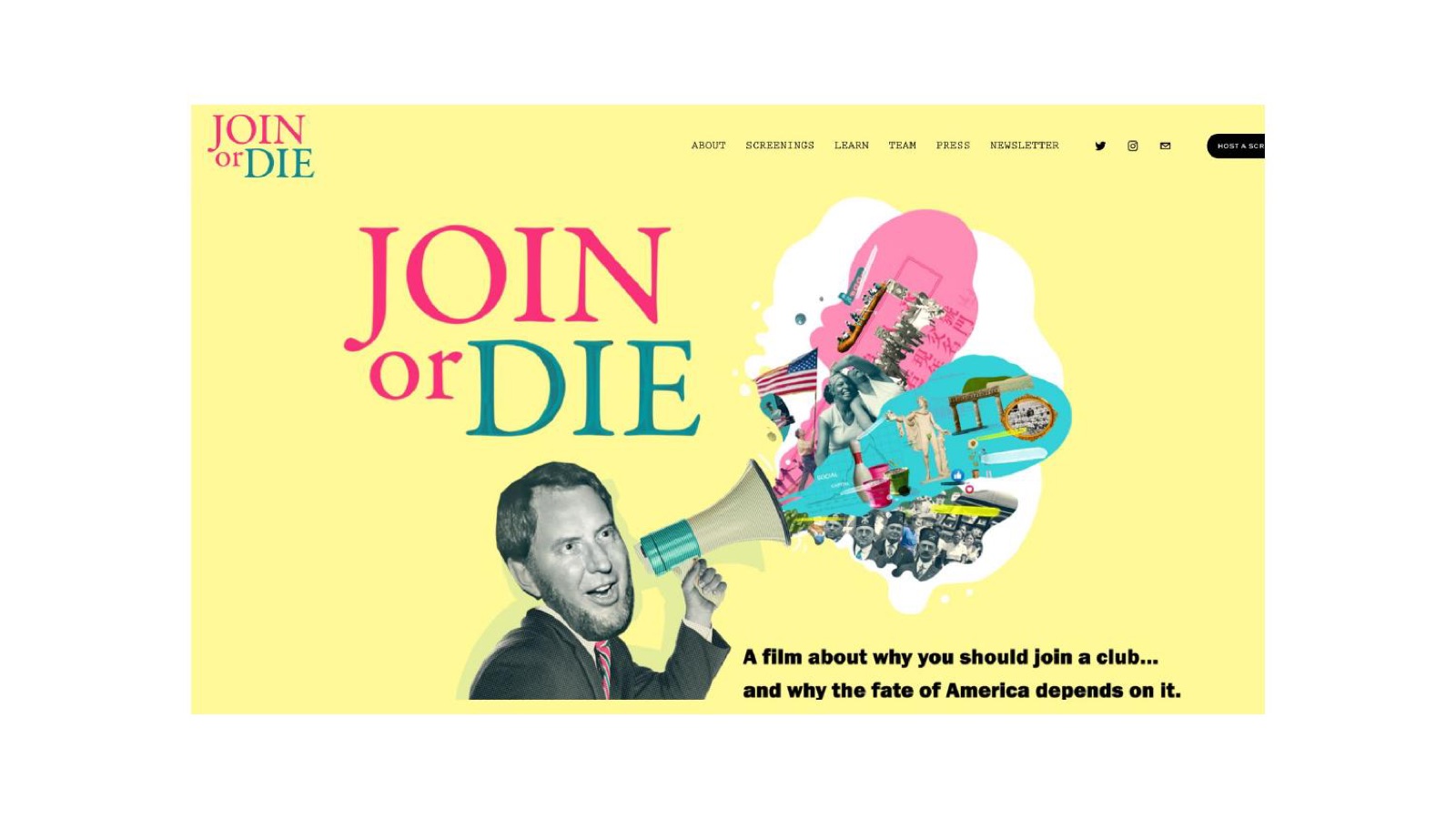
"Your chances of dying in the next year are cut in half by joining one group."
That is from the 2024 documentary "Join or Die," about sociologist Robert Putnam, author of the classic work, Bowling Alone.
So let me ask you: shouldn't education feel like joining something? Shouldn't enrolling at a university, including as an online student, confer at least the same, if not more, benefits as joining a bowling league? Don't we want that for our students?
And if we're not confident we're conferring those benefits, might it be worth rethinking the social capital component of our programs?
Economic:
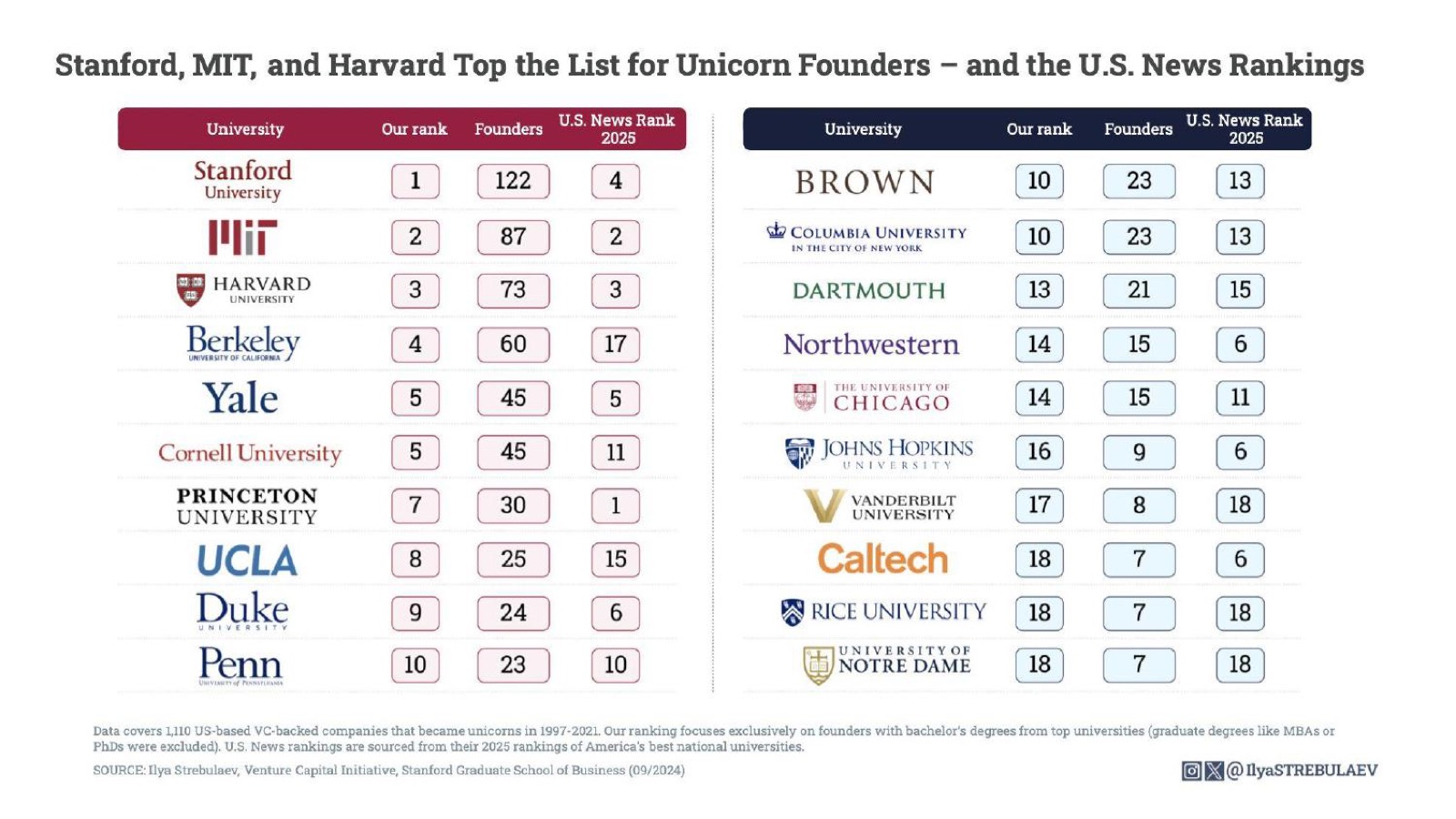
Have you ever wondered why Stanford produces so many startups?
It's not because we teach different skills.
It's about social capital – the dense networks that help founders find co-founders, and then plug into Silicon Valley, where they can raise venture capital and get advice.
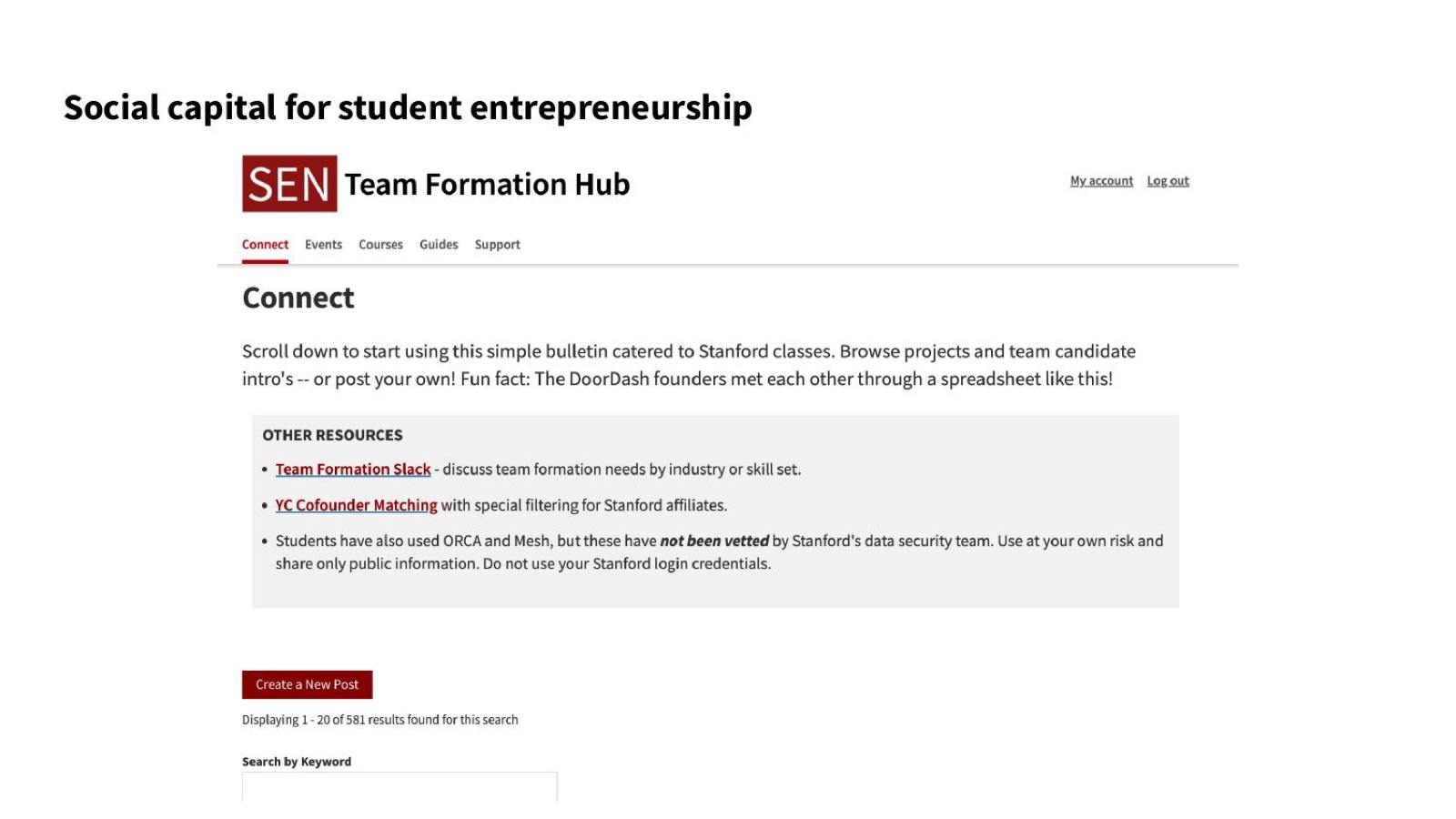
This is one of the secrets of entrepreneurship at Stanford. It's called the Team Formation Hub. It helps engineering students find MBAs to co-found companies, and vice versa.
Is this an online learning platform? Not as conventionally defined. Instead, it's a social capital platform that helps students build complementary teams.
Social capital works for finding jobs as well as co-founders.
In his classic paper "The strength of weak ties," the sociologist Mark Granovetter showed that social capital is how people get jobs.
Raj Chetty showed that friendships across socioeconomic strata drive innovation and social mobility.
When it comes to economic opportunity, who you know is more important than what you know.
Social capital helps to make Stanford among the most powerful social mobility escalators for low income students.
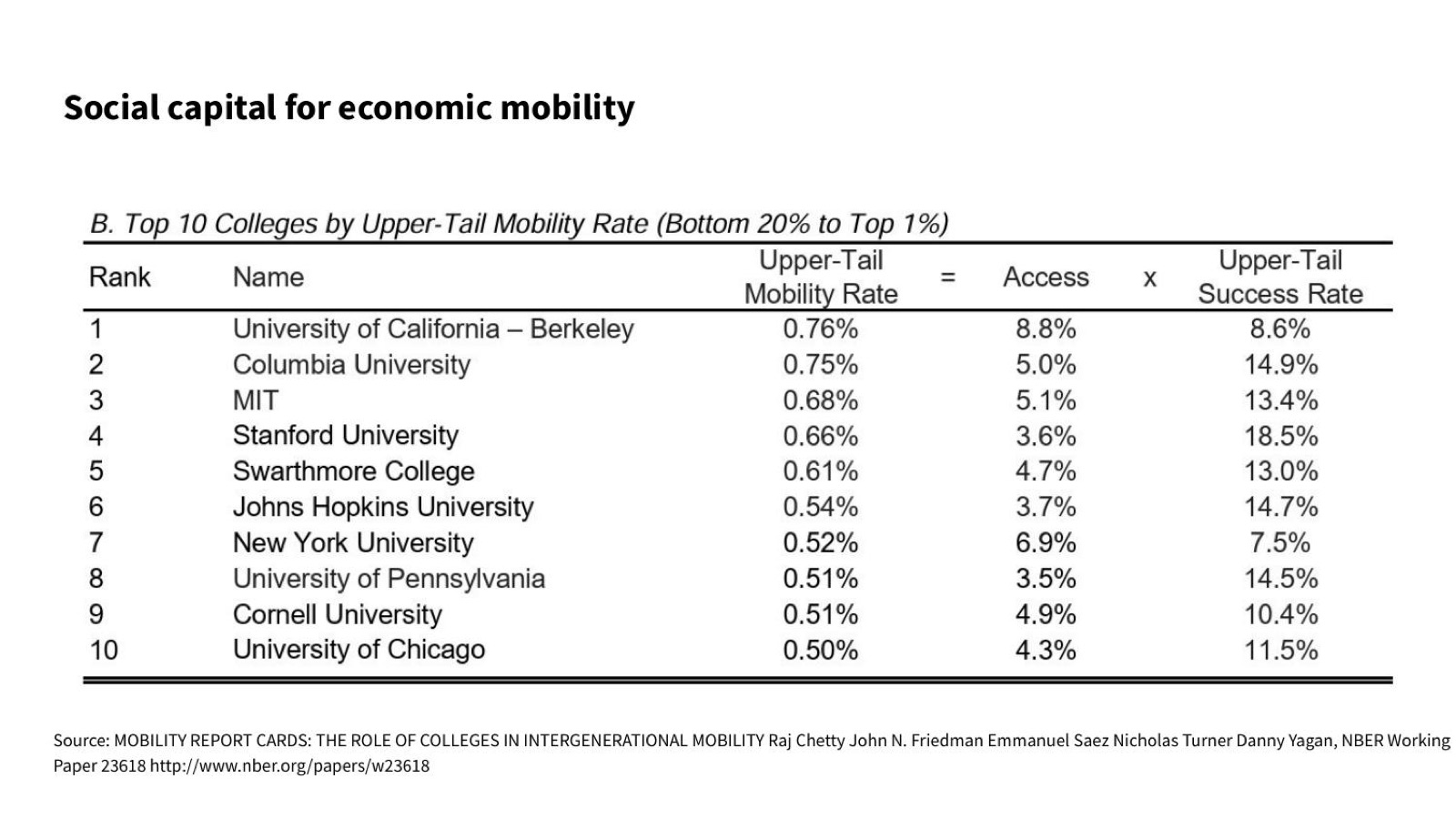
This is probably the chart that makes me proudest to work there.
Political:
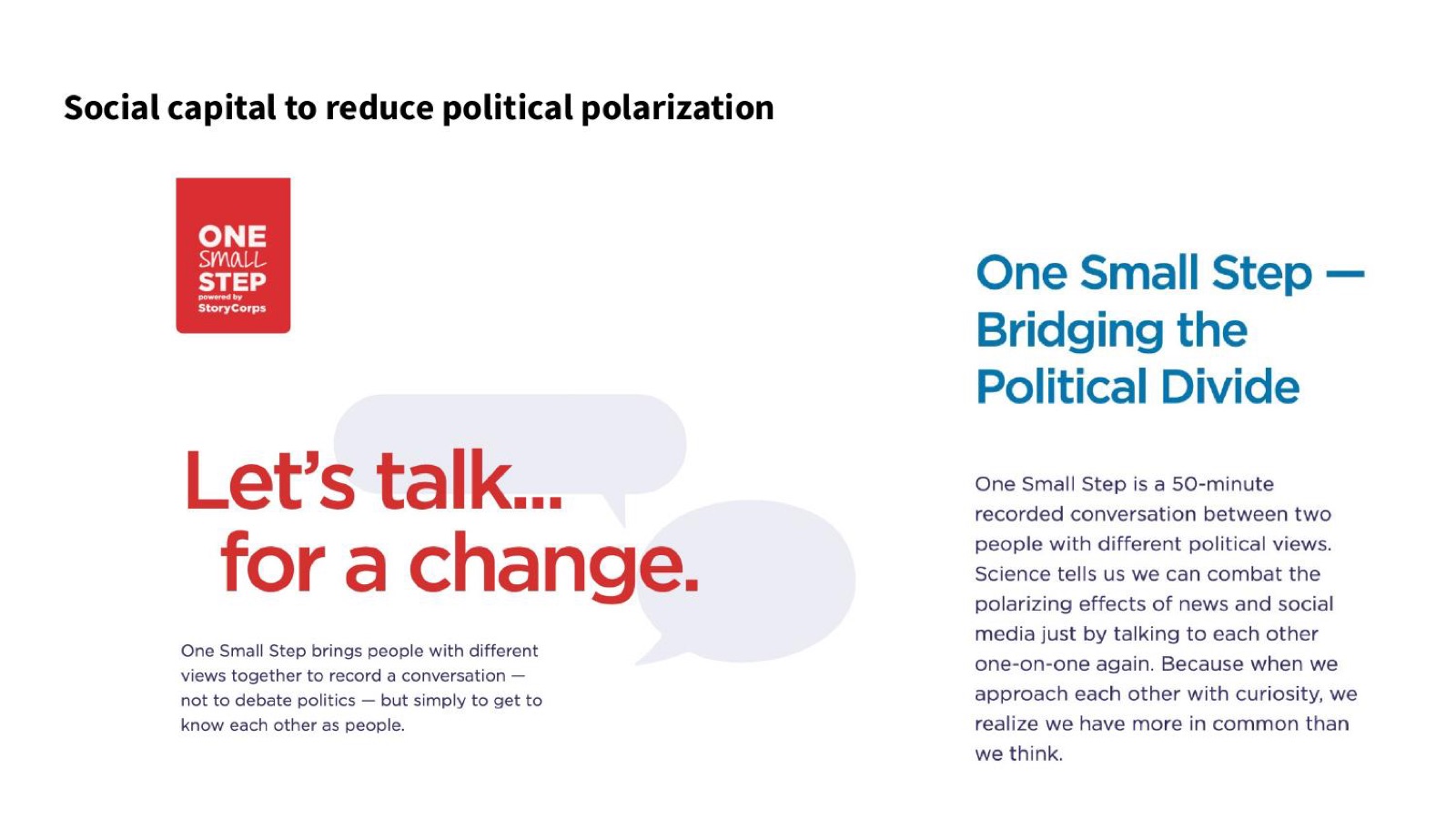
Here is a quote from Dave Isay, founder of StoryCorps and One Small Step:
"Around 2016, I started thinking about toxic polarization in the U.S. and becoming concerned about it. Not the fact that we disagree with each other — arguing is healthy and great — but if we can't see each other as human beings anymore…"
"[Listening] is, I guess, countercultural. But I don't think we are in the minority…. Our only agenda is that all of our stories and lives matter equally and infinitely."
It was these insights that led Isay to found One Small Step, as a spinout from StoryCorps.
Again, is this an online learning platform? Is it an educational institution? Not as conventionally defined.
It's a nonprofit that is helping to overcome polarization by encouraging listening and understanding.
I would say this is personal learning, not personalized learning. And I think it's an effective approach to bridging our divides. Maybe there's a model here for those of us who work inside traditional institutions.
Higher education can be thought of as a bundle of skills and knowledge, social capital, mindsets, intellectual exploration, athletics, etc.
In order to scale higher education online we had to unbundle it.
That unbundling over-indexed on skills, and under-indexed on social capital.
One reason this happened is because content and assessments were the parts of education that were relatively easy to scale with the technological limitations of the early 2000s, when online learning began to take off.
And of course skills were what the human capital system demanded. So as it unbundled college, online education became a more extreme version of the skills centered human capital model.
Today there are two factors that are motivating change in the way we think about online learning.
First is that the value of skills and knowledge in the labor market is evolving. It's not just that some skills are declining and others rising. That happens all the time.
What's happening now is a more fundamental recalibration that calls into question how we think about human productivity and the creation of value. That is what Deming and Silliman were getting at.
And second, it's now possible to scale social capital-driven learning models that strengthen human connections, understanding and community, alongside skills.
In my last section I want to talk about how to scale social capital.

Does anyone here play online chess? What about multiplayer games like World of Warcraft? It's ok to admit it!
What these games have in common is that they are simultaneously synchronous and asynchronous.
You can log in and find people to play with, live. I went to Chess.com late last night and there were 124,000 people playing.
But players still get the flexibility of an asynchronous experience – since you can play in any time zone, at any hour of the day.
You can find community and build teams.
You can learn to communicate and collaborate.
This sounds a lot like the "joining" that Robert Putnam was talking about, right?
Now imagine online education could combine the flexibility of asynchronous learning and the social capital benefits of shared synchronous experiences?
The online learning innovator Paul Freedman presented this challenge when he came to my class several years ago, and it's stayed with me.
To achieve this requires scale. It's only possible with scale. You need thousands of people logging into the same course in order to guarantee that they can find a live discussion or section.
And that is what Prof. Chris Piech has done with Code in Place, a free online course from Stanford that was launched during the pandemic – thus the name – with the explicit goal of reducing isolation and increasing human connection.
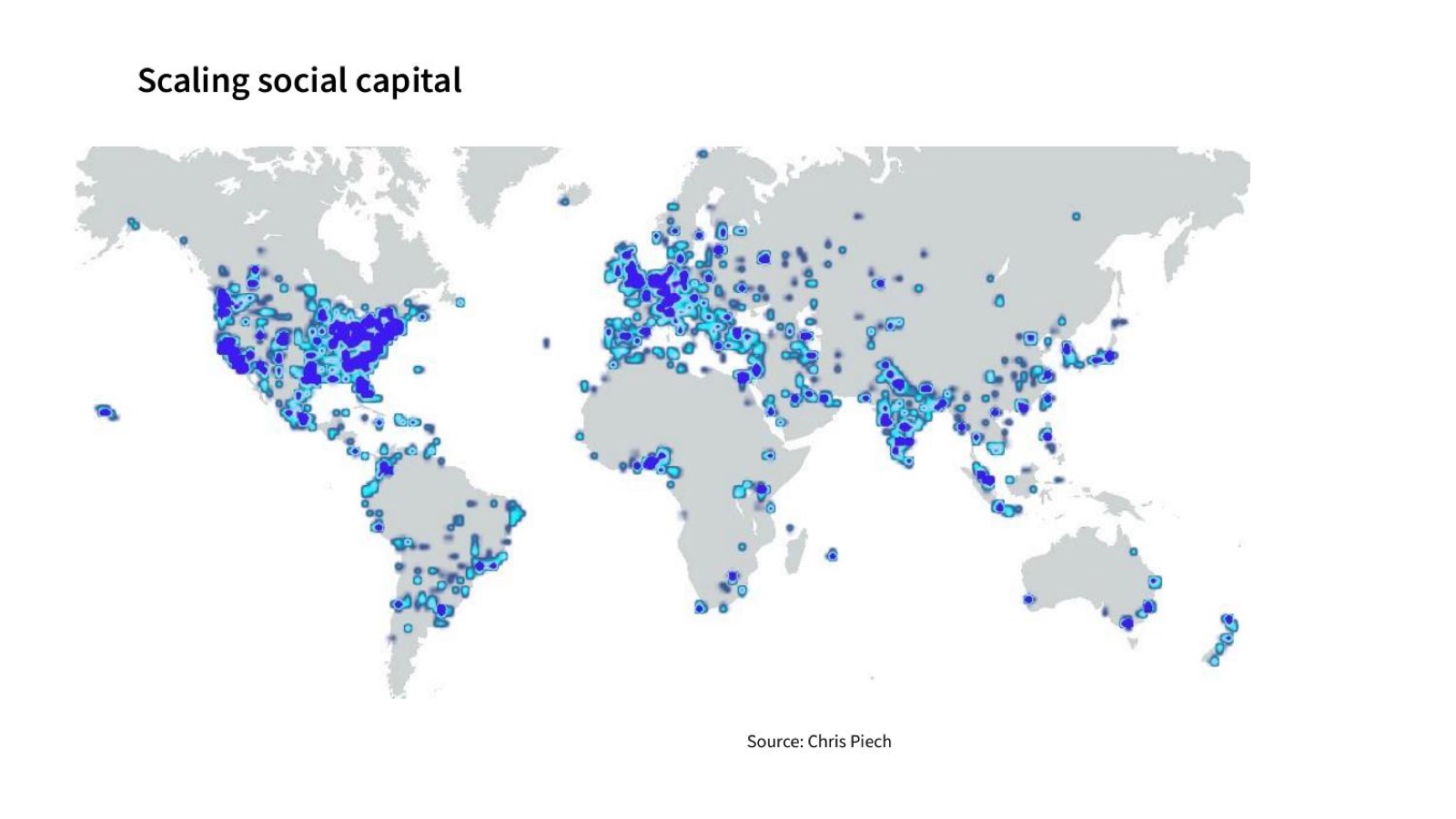
Code in Place is an online programming course based on CS106A, which is the most popular course at Stanford and the gateway to the CS major.
About 12,000 students around the world take the course each spring. They do so in sections of 10 students led by a section leader. So we recruit and support 1,200 volunteer section leaders. A cohort of 20 section leaders is then led by a teaching leader.
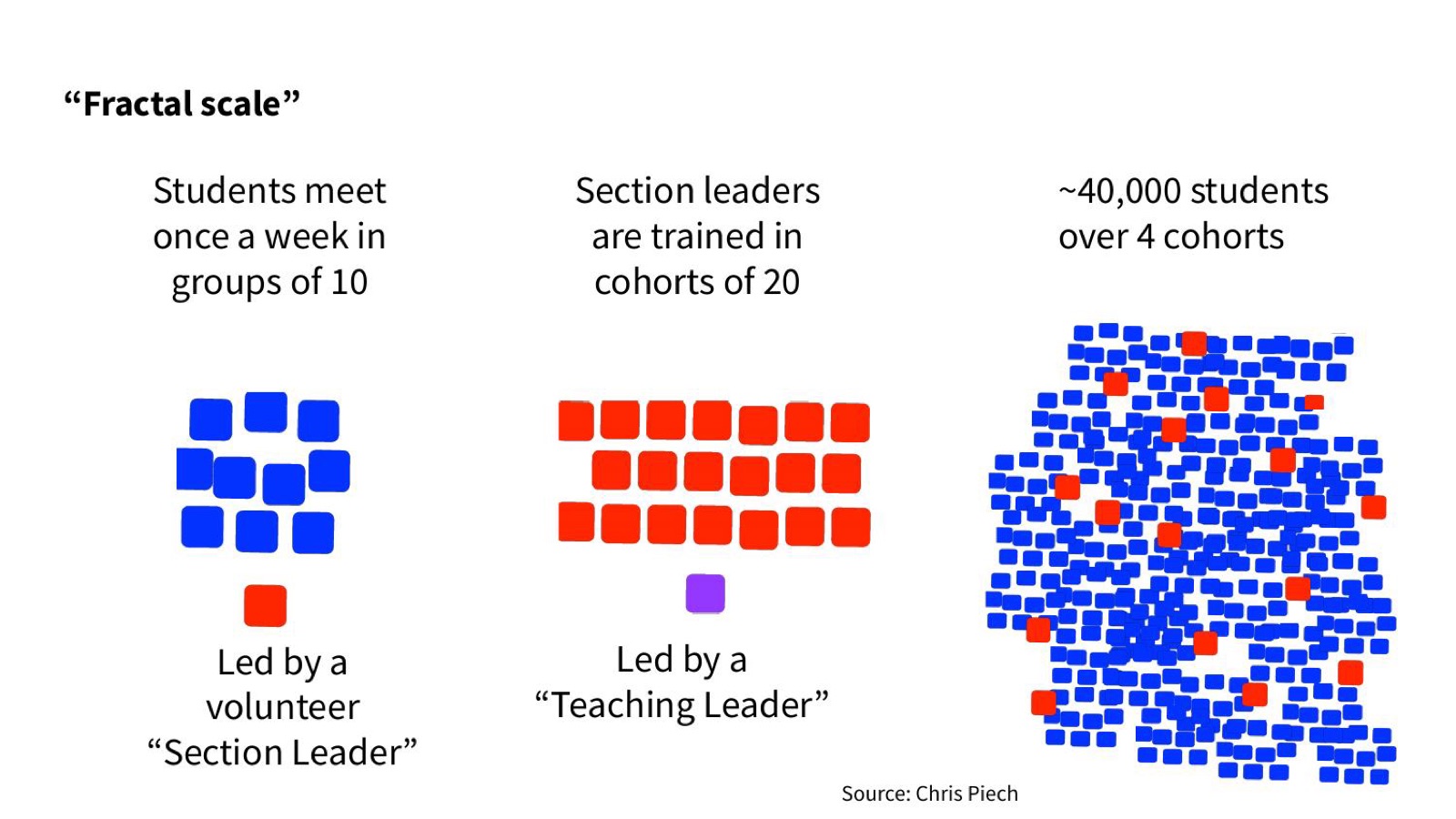
It's a different approach to scale that balances the benefits of a human teacher and a cohort with the benefits of geographic and temporal flexibility.
I call this the meso scale of learning, in between the micro scale of f2f on campus, and the mega scale of MOOCs.
There are five characteristics of Code in Place that I want to mention:
- It mixes asynchronous and synchronous components, as I mentioned, with weekly live discussion sections offered in every time zone.
- It is led by human teachers, supporting small groups of learners. The teachers have AI tools that enhance their ability to help learners, yielding better learning outcomes than a fully self-paced, self-directed online course
- It draws on our existing learning communities of students and alumni volunteers, some of whom serve as section leaders, and extends their impact through technology
- Because it's happening at a research university like Stanford, Chris and his colleagues run several randomized controlled trials inside Code in Place each year, and publish the results
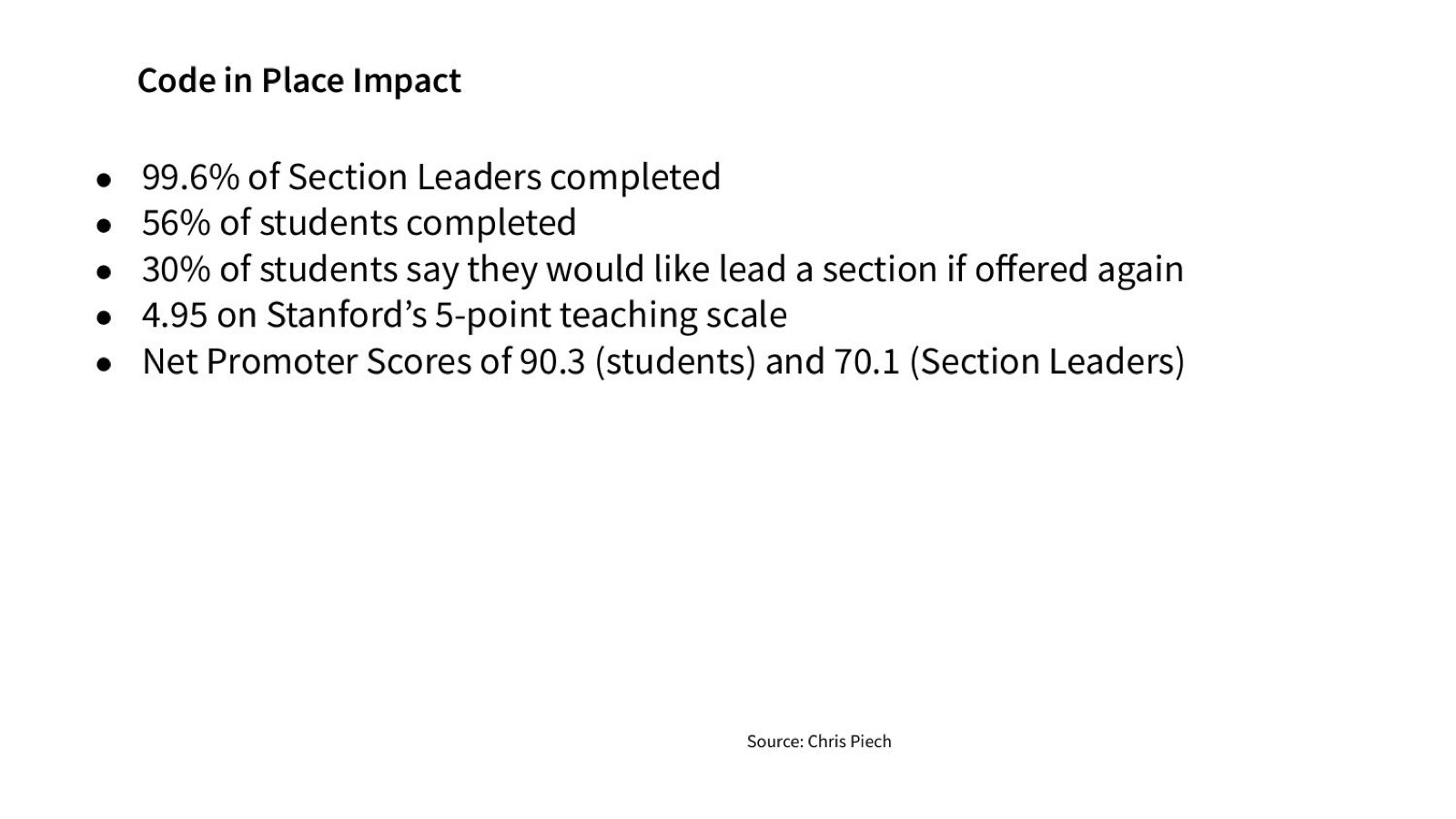
But what's most remarkable about Code in Place in particular and this model in general is that it gets better with scale.
There are network effects. The more people who are part of a course, the more likely they are to find someone to connect with on their schedule. Bigger is better!
That subverts a common higher education bias against scale.
If you are intrigued, I encourage you to sign up to take Code in Place, or to teach it. The website is codeinplace.stanford.edu (opens in a new tab).
Even if you don't, I hope this model inspires you, as it does for me. Perhaps it will help us reimagine online learning to scale social capital as a psychological, economic, and political imperative.
Thank you so much for listening.