Mike: At this time I'd like to enjoy and introduce our keynote speaker, Matthew Rascoff. Matthew just came to Stanford this past March from Duke University, where he was the associate Vice Provost for digital education and innovation. He was the special advisor to the Provost for educational outreach and digital innovation, and this past October was appointed the Vice Provost for digital education. This afternoon he'll share his thoughts about the vision behind the creation of Stanford's new digital education office and how innovation can be harnessed to increase opportunity. So with that, please welcome Matthew Rascoff.
Matthew Rascoff: Thank you, Mike. So glad to be with you all today, and wonderful turnout — I see 51 participants in this. I definitely have not met 51 people working in this space here, so my own circle has been increased by participating today, and I hope that's true of many of you here.
I was only given 10 minutes, so I'm not actually going to talk too much about our team, other than to encourage you to look us up. Stanford Digital Education is the name. We're new to Stanford, although many of the faces will be familiar to you, including Cindy, one of the co-organizers, who's one of the founding members of our team. And you know, our mission is to help Stanford figure out how we can use our people and technology in order to solve bigger problems in society than we have asked of digital learning before. So we're trying to bring together these two conversations, one of them about digital transformation and the other about the public role of even private universities to solving — so to solve those big problems. And in our team, in our mission, we are uniting those two challenges and saying that we should be thinking about all of our resources at Stanford, our technological and our human resources, in different ways and taking on bigger social challenges.
So our pilot project, which you can see on our website, is a new dual enrollment collaboration that allows talented high school students to start taking courses for credit online from Stanford, and we have more in the works, and I hope you will engage with us. We have many public programs, including a new book series that I'll ask Cindy to link to in the chat, called Academic Innovation for the Public Good, which is open to the whole Stanford community and is also syndicated to collaborative universities around the country that are working with us to kind of build a national movement around these issues.
So what I have for you today, though, is something actually a little bit smaller, and it's more of just a parable from my own learning and my own experience, and the impact that learning technology can have if we position it in the right way, and especially if we embed it with educational values. So let me try sharing my screen, and Mike, I hope that is visible to you. Maybe you could just give me a quick thumbs up — thumbs up if you're able to see that. Good. Okay.
So this is just like a little short parable about the impact of digitization, open source, and learning technology, and collectively how those three things can add up to something that I think is substantive and impactful on education, which is what we're all aiming for. So let's start with a little bit of early modern edtech. The press that you see on the left here — both of these are from Wiki Commons, by the way — the press on the left is similar to the one that produced the book that you see on the right, which is of course the Gutenberg Bible. And the Bible is usually considered a traditional religious text, which of course it is, but at least since Gutenberg it's also been a leading indicator of innovations that might become more widespread in the future, and that's kind of the context that we'll be talking about today.
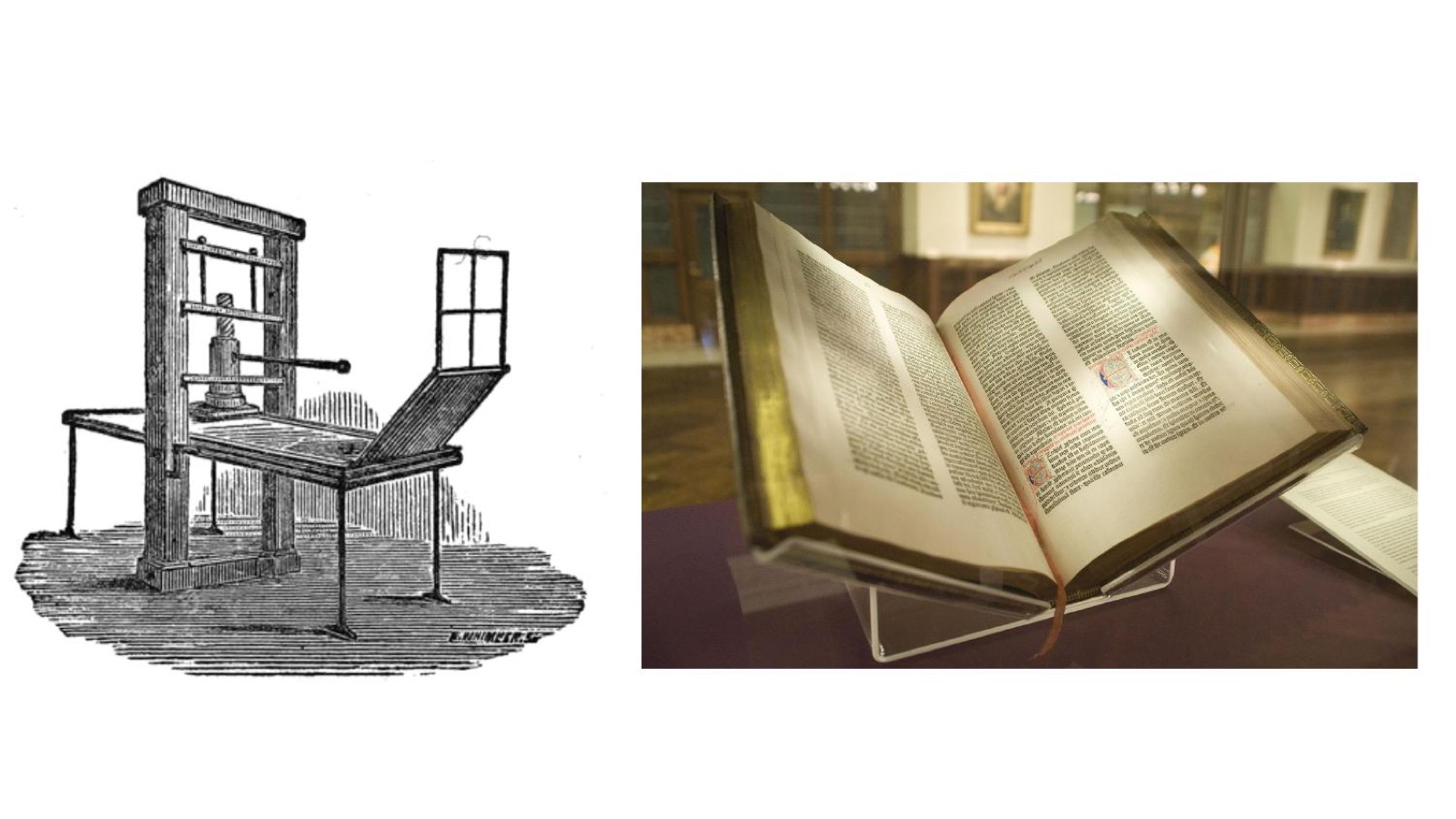
So in the 15th century that innovation was obviously book publishing, and you know, the Gutenberg Bible was the first book to be published on the press, and the press was an early modern technology that catalyzed an information revolution, and then the Reformation as well. Today, what I'm going to talk about, though, is digital innovations and how we might use the Bible similarly as an indicator of future trends, and what is happening with digitization and kind of the technology around it might actually show the potential for other kinds of texts and other impacts that we might have.
So this next slide, this is kind of a step backward. If printing, you know, was the innovation of the 15th century, before there was printing there were manuscripts. And what you see here is a Torah scroll, which is a handwritten manuscript scroll of the first five books of the Bible, the five books of Moses, which is read each week in synagogues by Jews. They read a portion of this from a manuscript just like this, and a reader chants to a very particular melody. But the Hebrew in this scroll, for the non-Hebrew speakers here, is written without notes and without even vowels. So the Torah reader has to memorize the vowels and the notes beforehand, and that is a tremendous learning challenge, and it's something I take on from time to time in my own synagogue.

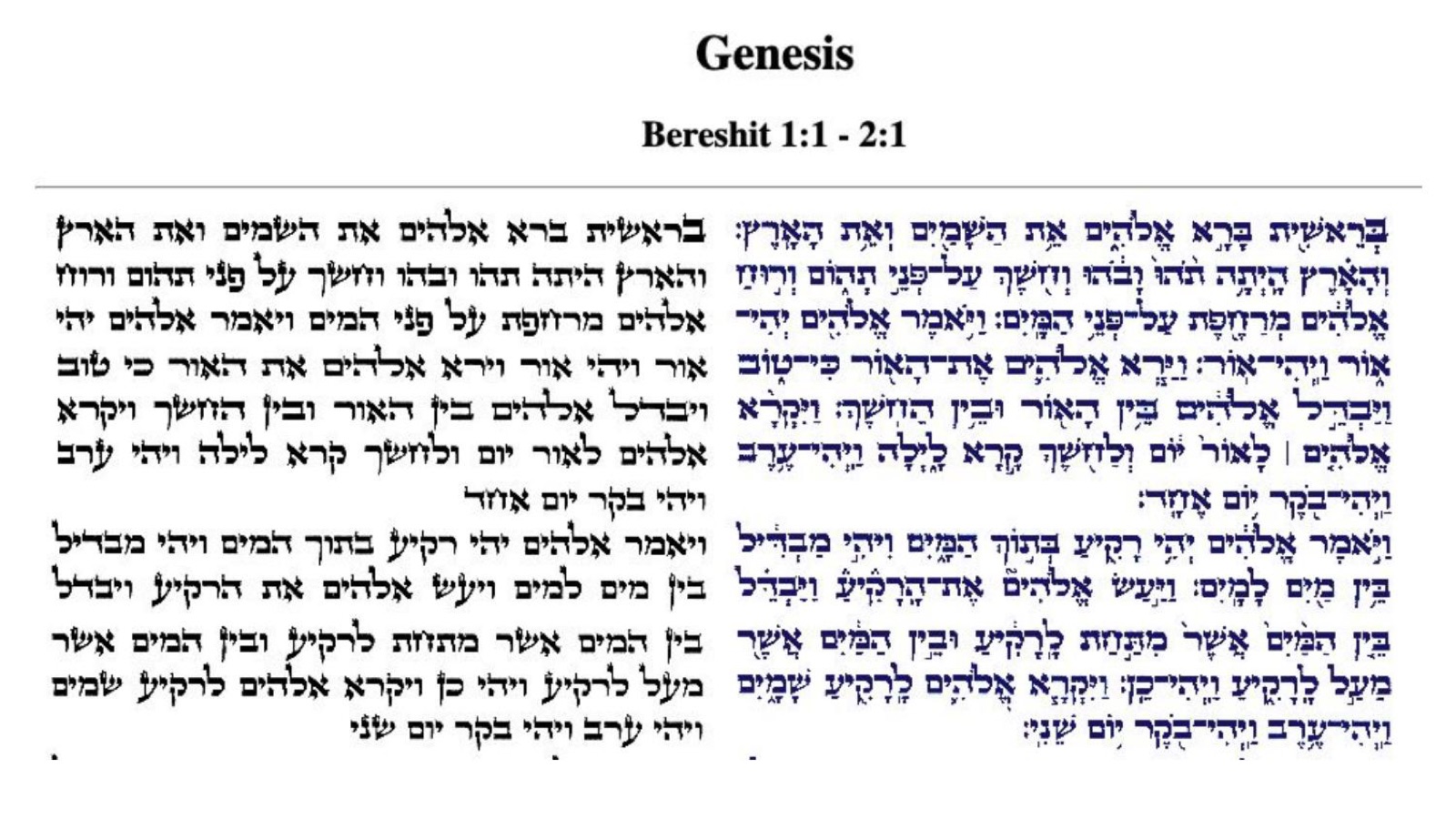
And the way you prepare to read from that document without notes and without vowels is using a book called a tikkun. And this is a scan from a traditional tikkun, which is a book that the Torah reader would use to prepare to read each week. And what you see here with a version on the right is that that's the Hebrew with the vowels and the notes, and the version on the left is a reproduction of that scroll text that does not have the notes and the vowels. And to prepare to read it in synagogue, you would typically go back and forth between these two columns, and scanning back and forth trying to memorize what those notes and vowels are, so that when you're up in front of, you know, the community and you're reading from that scroll, you know what you're doing. It's a really labor-intensive, challenging process that takes many hours for most people to read even a, you know, fairly short portion, and it's a pretty high barrier to participation in synagogue.
But what I'm going to talk about is a kind of a learning technology innovation in this very narrow space that I think has broader implications, that accelerates the learning process, and it happens in three steps. And I think those three steps are actually kind of exemplary and maybe, you know, show what might be possible in other areas of learning technology.
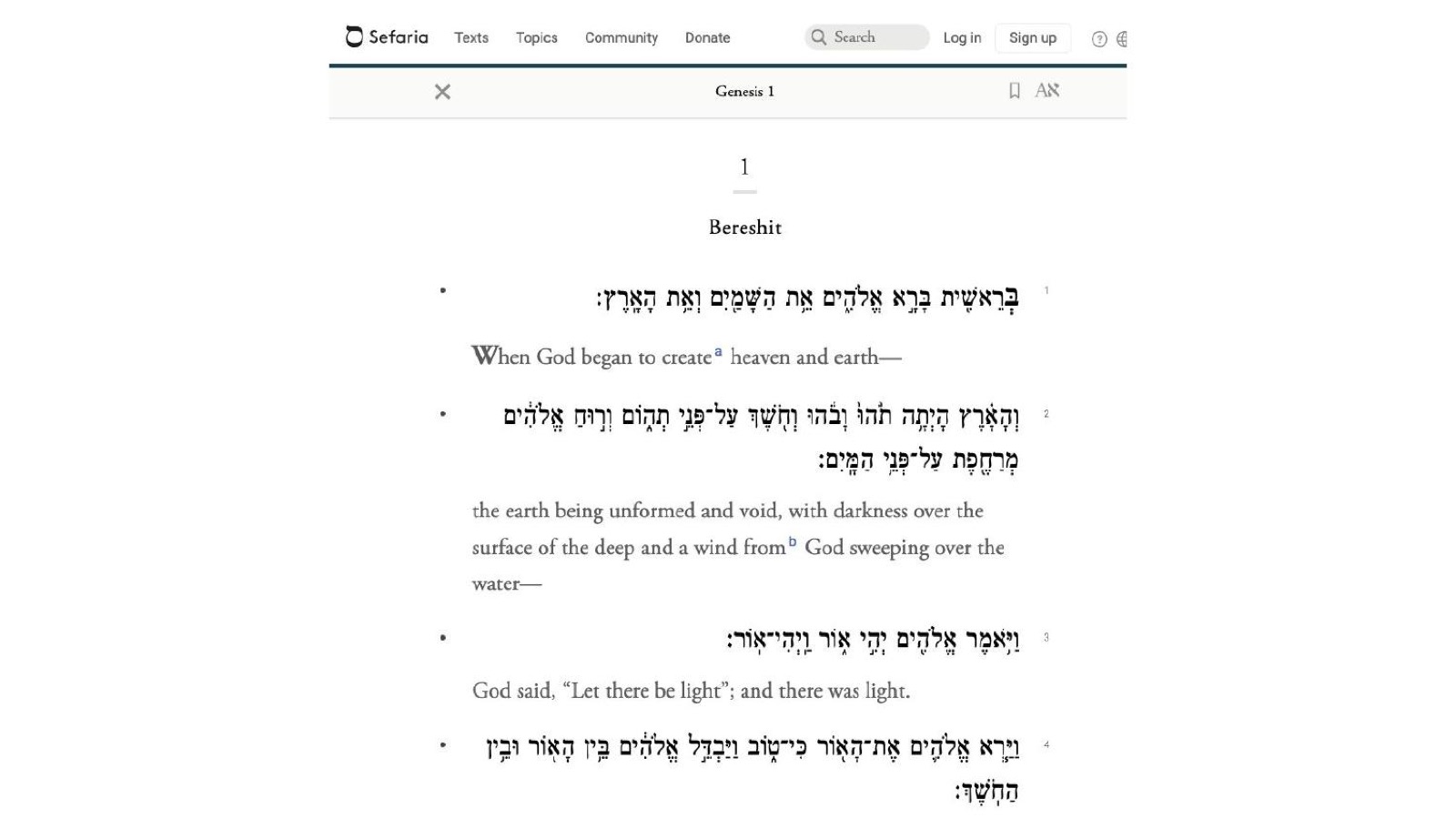
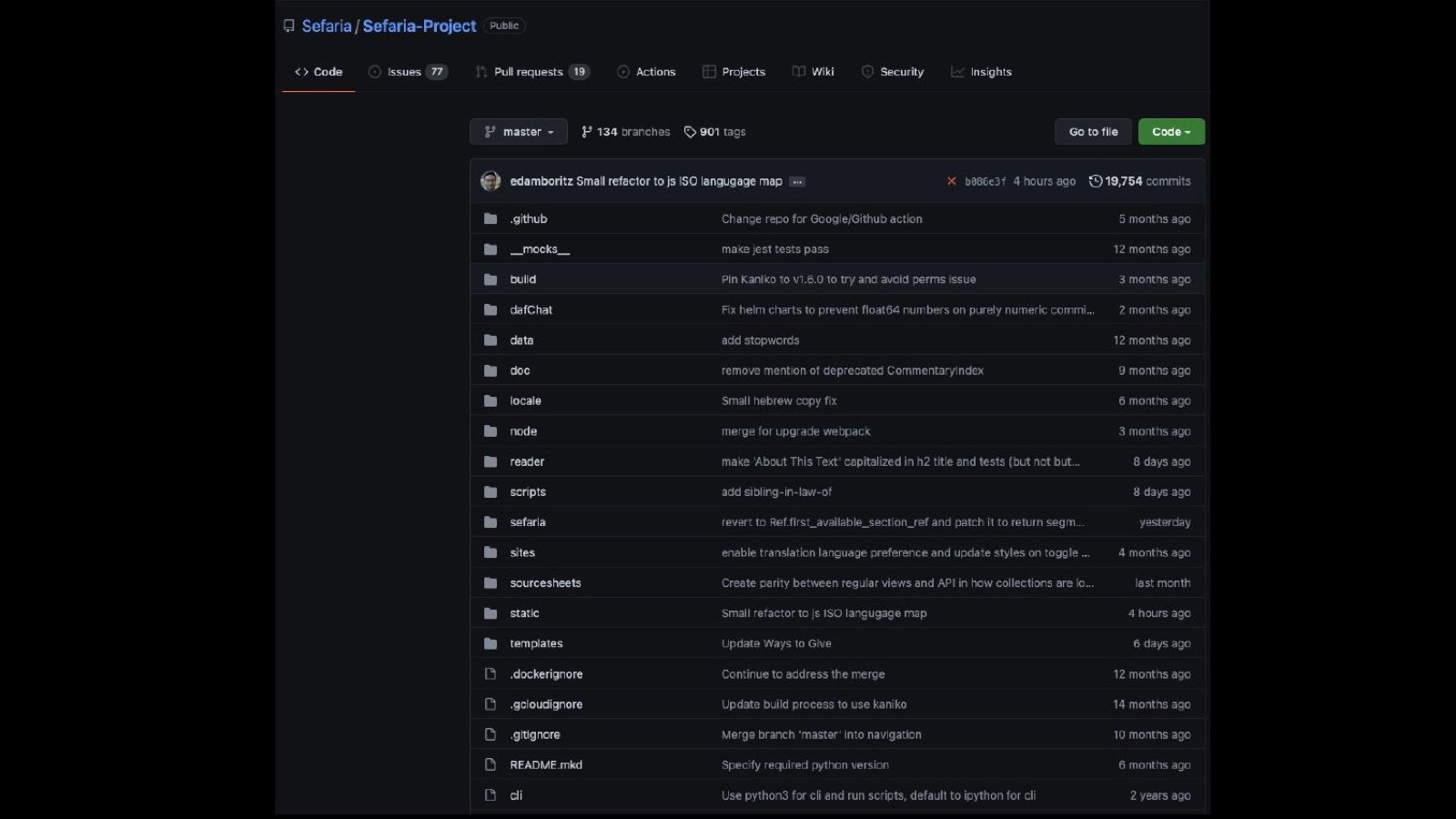
So step one was scanning and OCR-ing the Hebrew text, and that allows us to present the text using, you know, modern technologies like XML, and the translations in beautiful online formats. This also makes them searchable, copy-pasteable, and hyperlinked across text with beautiful visualization. So this scan and OCR was done by a non-profit group called Sefaria.org, which is a wonderful non-profit organization. But they didn't stop there. They went a step further, and what they did after they scanned and OCR-ed these texts was to make them available with open APIs. They also open sourced all the code that operates their site and allows these texts to be presented. So essentially what they did here was reimagine these classical Hebrew texts as open educational resources, and even the interface to access the open resources became an open source project. And that's the GitHub that you see here, which is Sefaria's, publishing both a text which you can download the whole corpus of, and also the code that powers their website.
Then the open source technology community kicks in, and this is step three. And step three is what happens when a community of innovators is able to tap into open source code, open source text, and open APIs. And I'm going to show you here with this video — I'm hoping this will play properly — what this fantastic innovator behind Tikkun.io is able to do. Now watch carefully what's going to happen. Do you see the vowels are turning on and off? So rather than presenting these two versions of the text, one with vowels and one without vowels side by side, what you see here is you can just toggle them on and off. This is just a recording of me doing this earlier today, and you click one button and you can toggle the text from the version with and the version without vowels, and it simply accelerates the process of learning how to prepare this. I can show you in a live demo, but that video really does it, and if you go to Tikkun.io you can see this in action yourself.
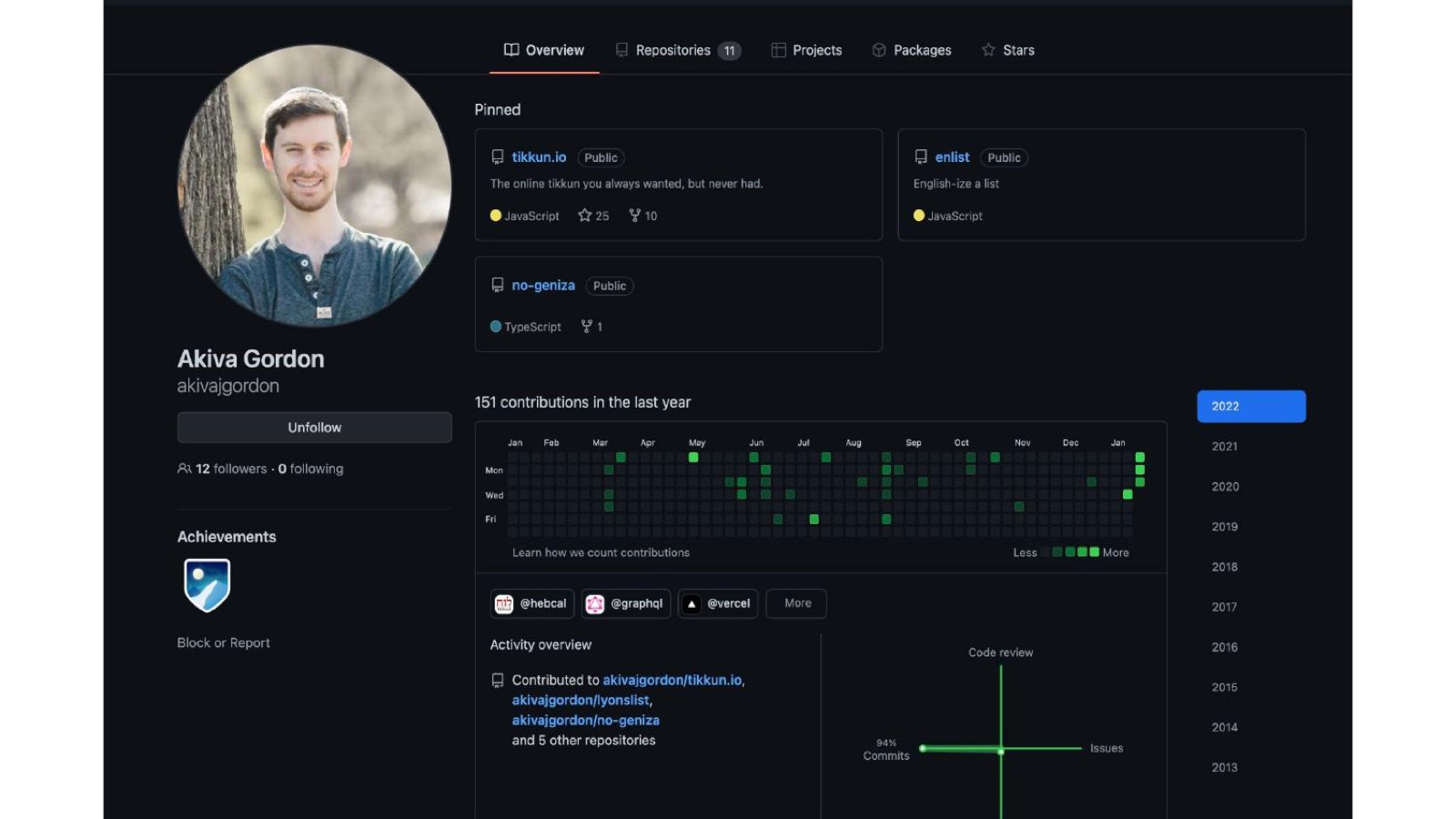
I think it's a really cool example, but to me there's also something really important here, that this is sort of indicative of what's possible with open source community. This is the guy, by the way, who built Tikkun.io. It looks like he's about 25 years old, and you can see all of the, you know, the pull requests and the check-ins that he's done, you know, to make this project possible, which has been happening since 2008. He credits in the readme here the source text pulled from the Sefaria API and some minor adjustments that he made, but he says clearly, you know, on his webpage, the mission is to make better Torah readers by providing the tools to maximize the reader's efficiency and prepare awareness. A good old-fashioned tikkun is great, but in the end they're just static papers, and what with a dynamic nature of computer programs, we can make an even better tikkun.
So just to kind of step back here and try to see, like, what is really happening, if you're not a reader of the Torah and you don't care particularly about this — to me, I think what we see is kind of a pyramidal structure of innovations building on one another. And this is, you know, kind of a pyramid that involves learning technologies that are based on content, but there's also some code, obviously — there's an open source project for the code — some interaction with that content, in this case it's memorizing, reading, trying to prepare, and the usual interaction is your eye scanning back and forth between the versions with and without. But you know what Tikkun.io did was design a better interaction that is more supportive of learning. And then a learning or research challenge, like a recognition that it's actually not optimal to go back and forth that way, but there's a better way to do this using fairly straightforward JavaScript that would allow you to toggle on and toggle off.
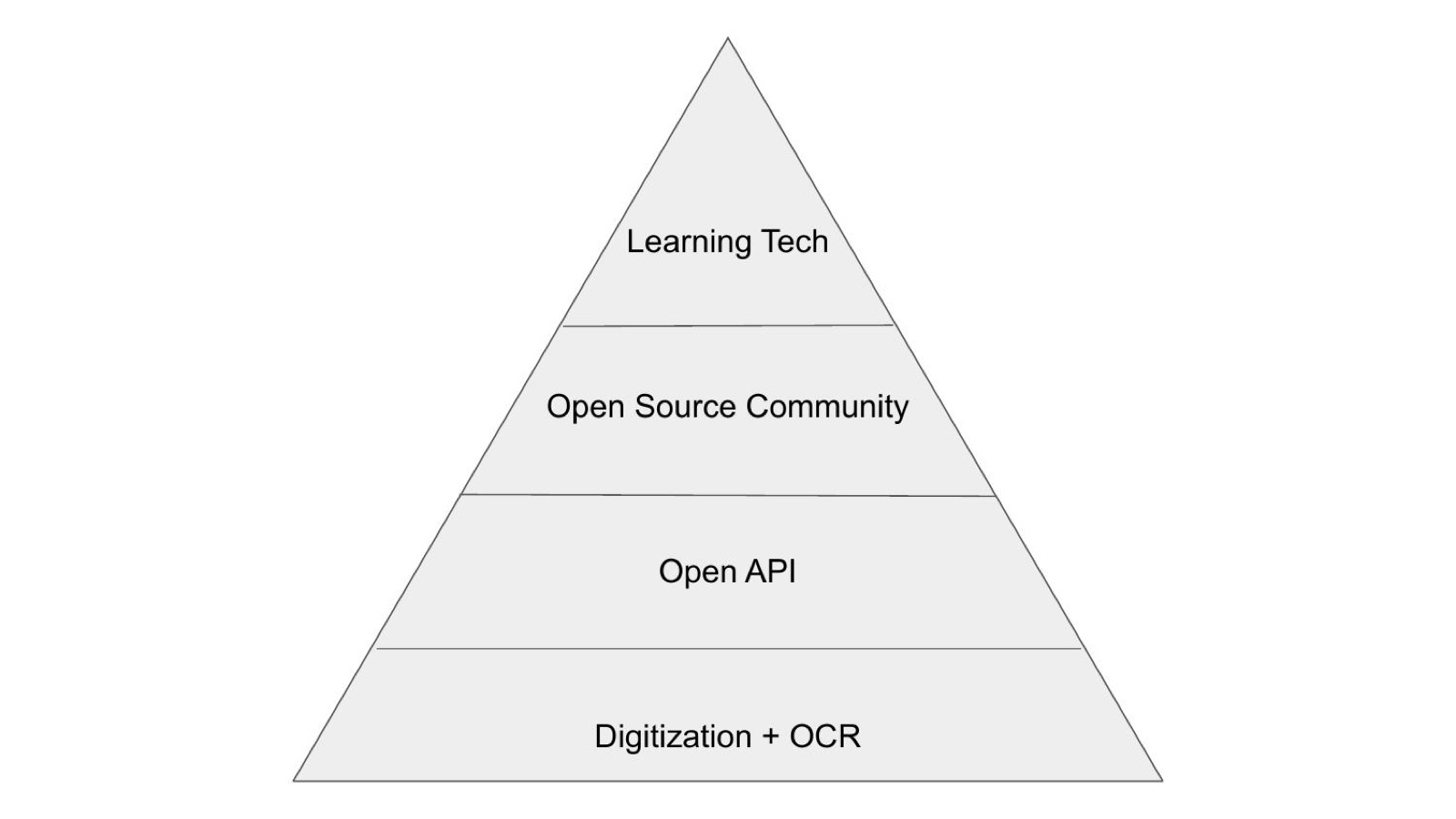
And I think what's really interesting and instructive, and I hope inspirational for you, is to think about other digitization projects that are kind of at the base layer of this pyramid, and how they might move up the kind of value chain of this pyramid. Imagine this as a kind of hierarchy of needs, and at the top of them is this potential for learning technologies that accelerate our ability to learn something new, whether it's reading the Torah or doing math or writing something, any hard learning challenge. And think about what is the corpus upon which we could build technologies like the ones you just saw, and think about this biblical text as a leading indicator, as it often has been in the past. With the Gutenberg Bible that was indicative of a printing revolution — what is the learning technology revolution?
So think about like the HathiTrust corpus, which is the open source version of the Google Books digitization project, that was turned on during the pandemic and made all of our libraries so much more available. That to me was an indicator of what's possible with digitization in response to a crisis. But the data behind HathiTrust has also been open sourced. I think it's possibly at the mid-tier of this pyramid. I haven't seen very many learning technology innovations come out of it. I think there are some research projects that have come out of the HathiTrust digitization. Think about the JSTOR APIs. JSTOR has digitized so many books and journal articles. Imagine the potential of building an infrastructure, or building a learning tools kind of application layer on top of the infrastructure of projects like that.
And the question that I want to leave you with is, how can we accelerate the movement of projects up a pyramid like this? If you buy this scheme, and if you think there's potential, you know, in models like this, what is the mechanism by which we could accelerate that process? And think about other corpuses, other kind of infrastructures that we have available to us, that could become the basis for new kinds of learning technologies and new innovations that are based on them.
That's all I've got for you today. I hope I kept roughly within my 10 minutes, but it's really a pleasure to be with you. I'm going to stick around for as much of this as I can, and I just want to thank Mike and Cindy for inviting me to participate in this. I'm so glad you guys have pulled this community together, and I'm glad this exists. It's something that we definitely need, and certainly coming out of the pandemic, you know, the recognition is clear, the potential is immense, and it's just wonderful to see the energy in this room and the interest that people have in this topic. So over to you, Mike, and thank you so much for having me again.