Host: Alright, ladies and gentlemen, welcome back to NTEL 2025. I hope you've enjoyed the morning session and gained a very different sense of learning and the different possibilities in the classrooms these days. Up next, we have a keynote by Mr. Matthew Rascoff, Vice Provost for Digital Education at Stanford University. A pioneer in ed tech strategy, Mr. Rascoff has led major transformation initiatives at Duke and now Stanford, and he'll share his global perspective on how to scale impactful, technology-enabled learning. And a reminder for everyone: if you have any questions, please feel free to drop them into Pigeonhole by scanning the QR code on the screen and entering the event passcode, NTEL 2025. With that, let's welcome Mr. Matthew Rascoff.
Matthew Rascoff: Hi, everyone. Good morning. Can you hear me okay?
Host: Good morning, Matthew. Can you hear us? We have here an auditorium full of educators and education developers, eager to talk about technology-enhanced learning, and we're really excited to have you join us from Germany to share with us today.
Matthew Rascoff: Thank you so much. I'm so sorry I cannot be with you in person due to health reasons, but I very much look forward to visiting Singapore and the Singapore Institute of Technology and coming to NTEL 2026, hopefully.
Host: I'm sure we'll find a way for this to happen at some point. Okay, Matthew, you're with Stanford University, driving innovation in education technologies, and I hope that means it's okay for me to start off with a bit of a challenging question. It's been almost twenty years since MOOCs were introduced, promising us affordable, accessible, equitable education for everyone. I think by now we were hoping all of our kids would graduate from Stanford, because it would be possible. But somehow it's not. So in your perspective, what went wrong?
Matthew Rascoff: It's a really important question to ask as we plan the next generation of education technology. Even optimists like me need a full accounting of what happened there. And I think I may have a slightly different perspective on this than others, which is that we need to ask, first and foremost, why is higher education so expensive in the first place? Why does it even have to be rationed in the traditional model? That framework really helps us understand what went wrong with MOOCs as they tried to make education more accessible and more democratic.
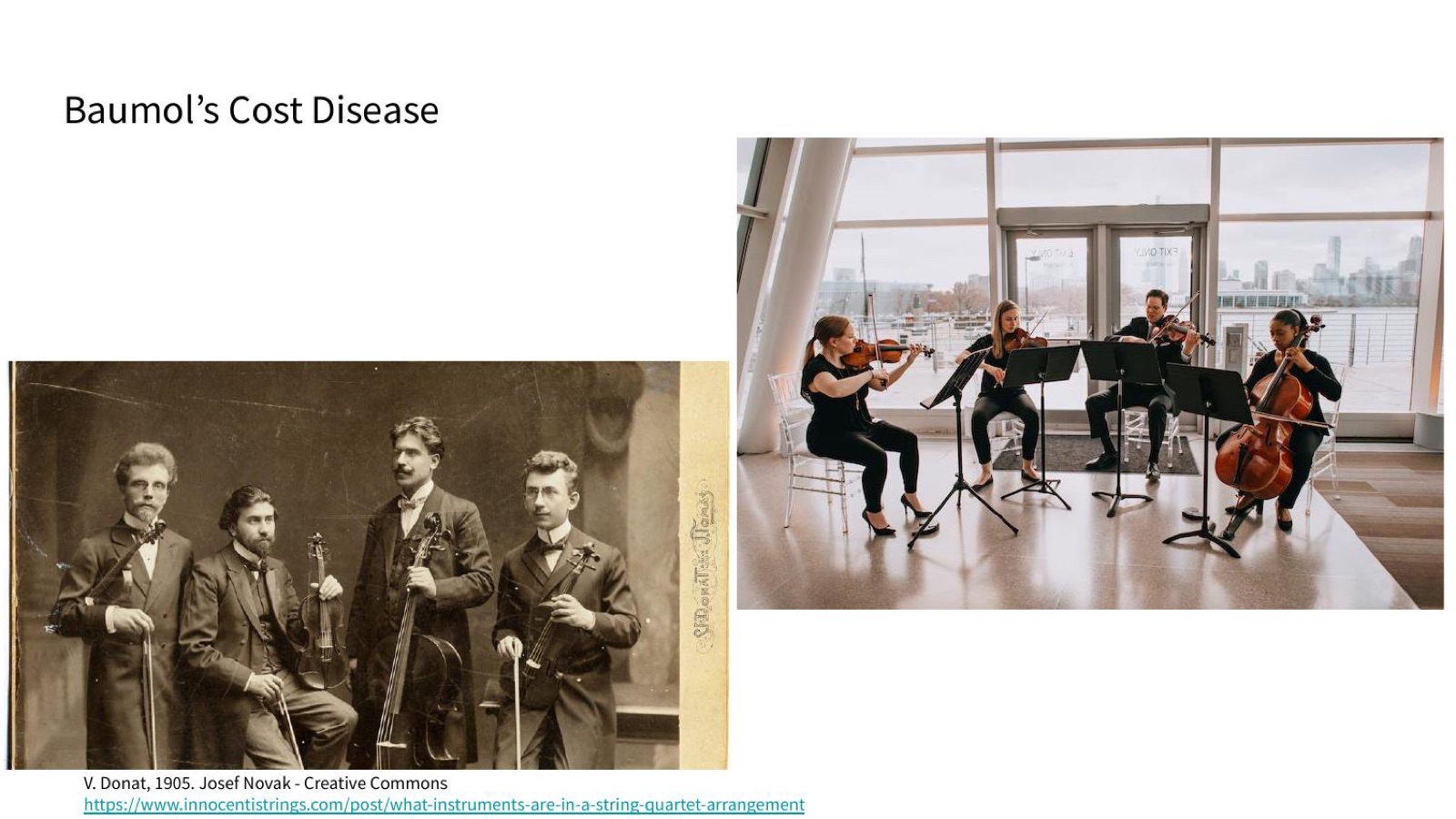
To me, the starting point is this concept of Baumol's cost disease, which explains why higher education is expensive and why its cost rises faster than the rate of overall inflation. I have an analogy that might be helpful — I hope you can see my screen. Let's use this analogy from live music. The string quartet on the left, that played a Beethoven string quartet two hundred years ago, has the same fundamental economics as the modern string quartet on the right: four players playing to a few hundred audience members live. Meanwhile, other industries experienced unprecedented improvements in productivity, which drove down their cost. If you think of a modern factory that can produce a car, it's doing so with a fraction of the labor content of a Model T a hundred years ago.
Digital education promised to solve this problem. It said we can bring productivity into education — a single professor could teach millions of people, not just the hundreds who could sit in a lecture hall in front of them. So the first wave of digital learning, particularly the MOOCs that you mentioned, tried to solve Baumol's cost disease by unbundling education, stripping out the content and lectures that could be scaled up the way that manufacturing might scale production, or that Spotify might allow a string quartet to reach millions of people.
But there was a fundamental error, and I think this is the diagnosis that's most important from my perspective: by focusing only on the streamable components of education, we missed out on the more valuable learning experiences and environments that come from community. That's really what I want to talk about today. The failure of the model wasn't just about the low completion rates. It was a more profound mistake that overlooked the social and communal nature of learning. To me, learning community is still the missing piece of most digital learning experiences. But now — and this is what I hope we can really talk about today — there are technologies that allow us to bring community back into digital learning. And in so doing, we now have ways to scale the benefits of truly great education. That, to me, is the AI-enabled future in this space.
Host: Thank you. You mentioned learning communities, and I think we've been using that term, but we may have different interpretations as to what it may actually mean. So how do you define it, and what do you find to be the essential elements of a successful learning community?
Matthew Rascoff: I have a few historical examples, and I've got some images here that illustrate them. We sort of have to look back in order to look forward. I just pulled up some of the great school models from the past that I've admired, and I think we can say that they're not just defined by pedagogy, or an extracurricular program, or facilities, or faculty, or students. Learning communities arise out of the interaction of all of these factors.
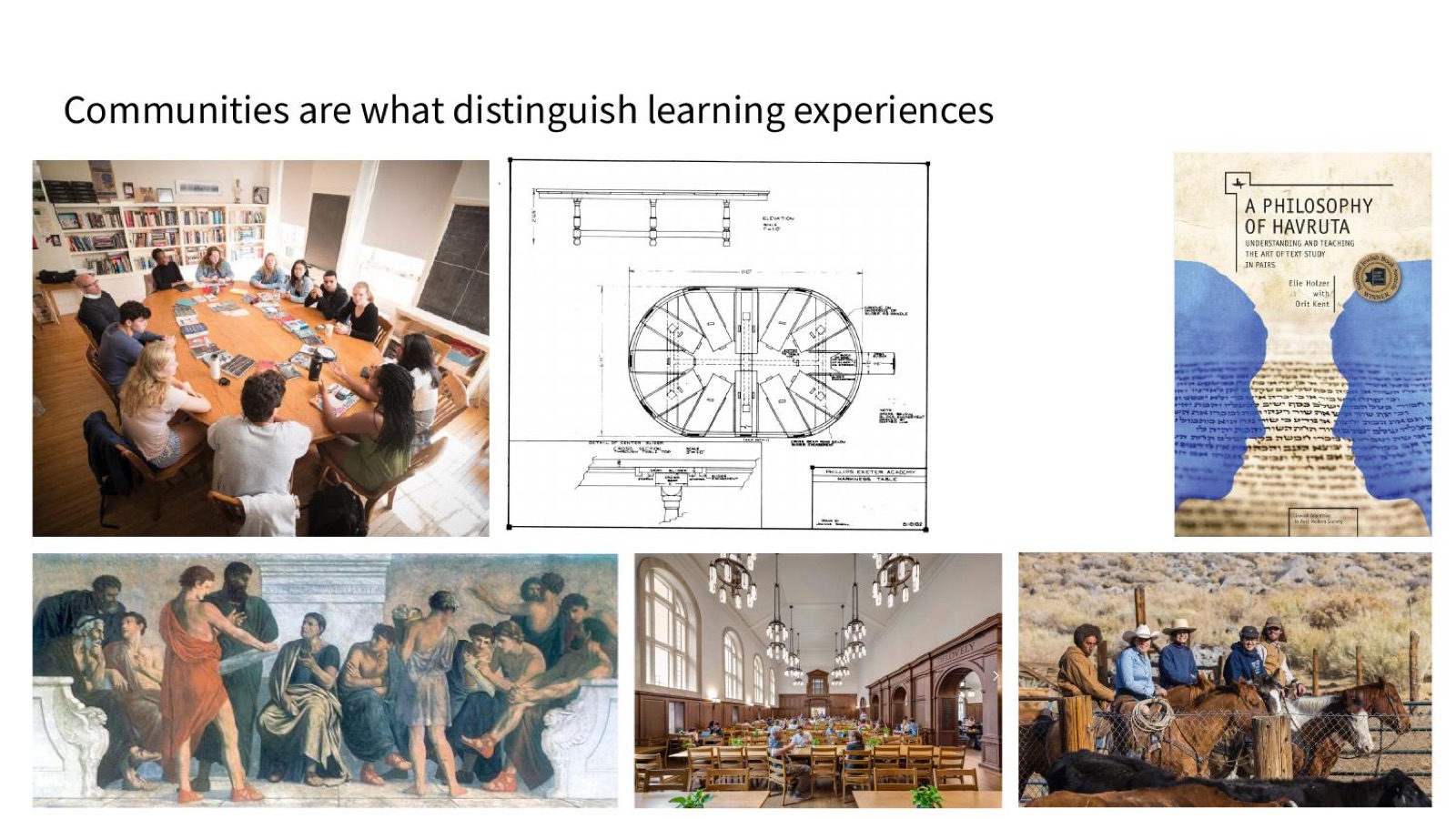
Just to illustrate some of these examples: On the bottom left, that's Aristotle's peripatetic school of philosophy. He would teach by walking around. It was mobile, it was conversational — you could join in, you could listen in to the conversation. He had a particular model of community that was embedded in the urban environment, and it was enmeshed. On the top right, I pulled up the rabbinic tradition of Havruta. It's built on intense paired learning — two people working together, deciphering complex Talmudic texts and trying to make sense of these really hidden topics, trying to understand complex ideas. On the top left, we have the Harkness seminar table, which was developed at a prep school in the US. It's a circle; students can teach each other, they grow together. The idea is that you're creating a community around the seminar table. They even have a kind of architectural diagram for what this table is supposed to look like, how many seats it should have — a very particular hardware learning technology associated with this. In the bottom middle, I have the dining hall at Yale University. That's a center of community, where students live together, dine together, and connect with one another in residential colleges. And on the bottom right, I have an example from Deep Springs College, where students learn by running a ranch together in rural California. They work the ranch, they spend part of the day taking care of the animals, and part of the day learning in seminars.
To me, each of these models has a thesis for how humans should interact, how they should learn together. They have a vision for what their ideal learning community should be, and each element of their school supports that vision. That kind of vision is the crucial building block that has been most missing from digital learning design.
Host: Right, and this all looks very low-tech. So how do we bring technology into this?
Matthew Rascoff: Some of these are more or less tech, and I think that's a good question. But to me, the stakes are really high. Before we think about the technology, we have to think about why — to what end? Why is learning community so important?
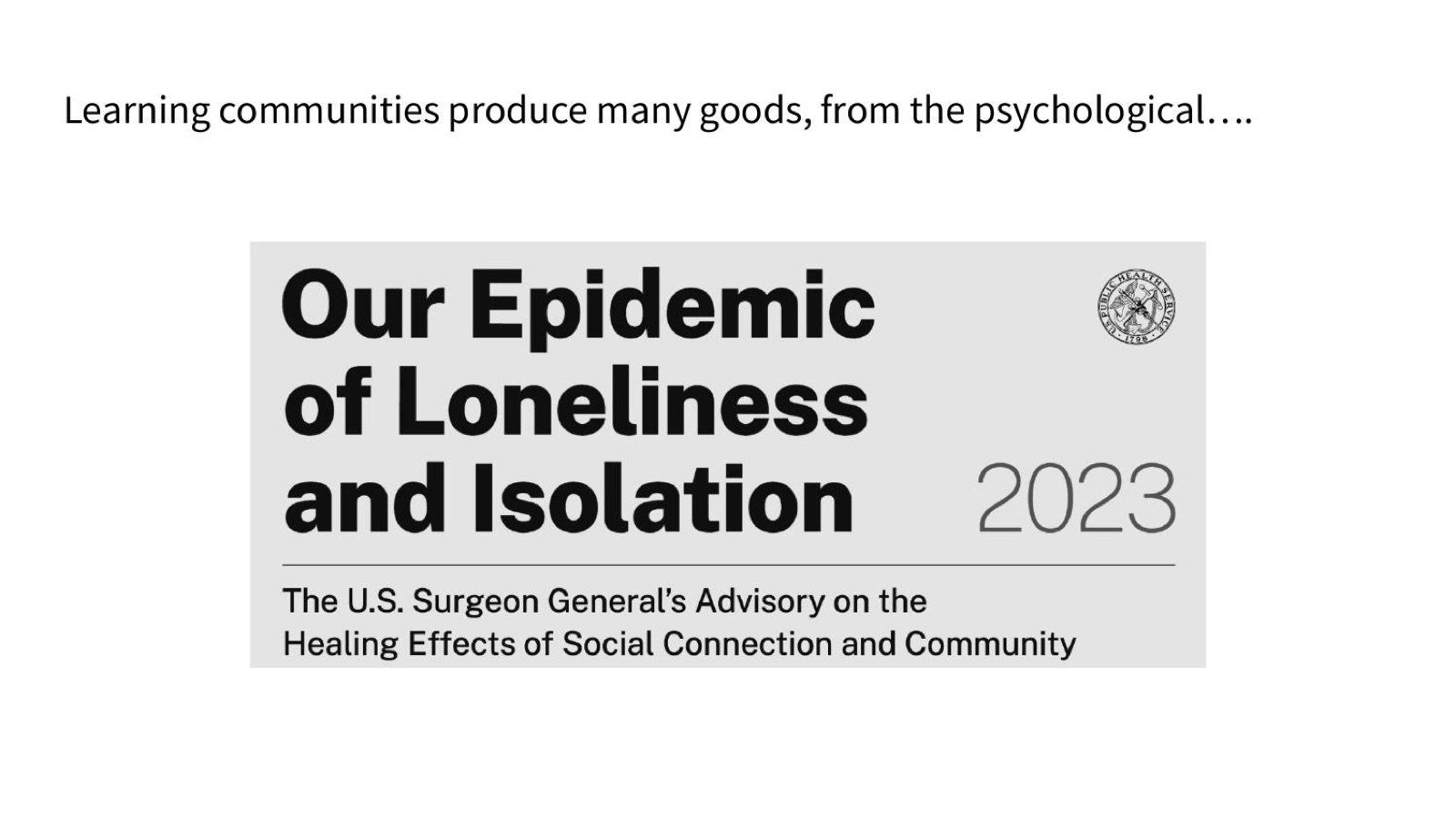
There's a psychological component. There's a Surgeon General's report from the United States that described a public health crisis of isolation and loneliness in the US that starts in schools. Community is the basis for the psychological well-being of whole societies. In the United States, we have a massive mental health crisis on colleges and universities. At Stanford, one third of our students are in psychological care. To me, that's a sign that we've missed something important in the needs of our students. It can't just be about one individual or another — there's a structural gap, and we've made a systematic error in the way we've underinvested in the social fabric that supports students' psychological needs. That is a huge challenge, and I think the technology needs to support it.
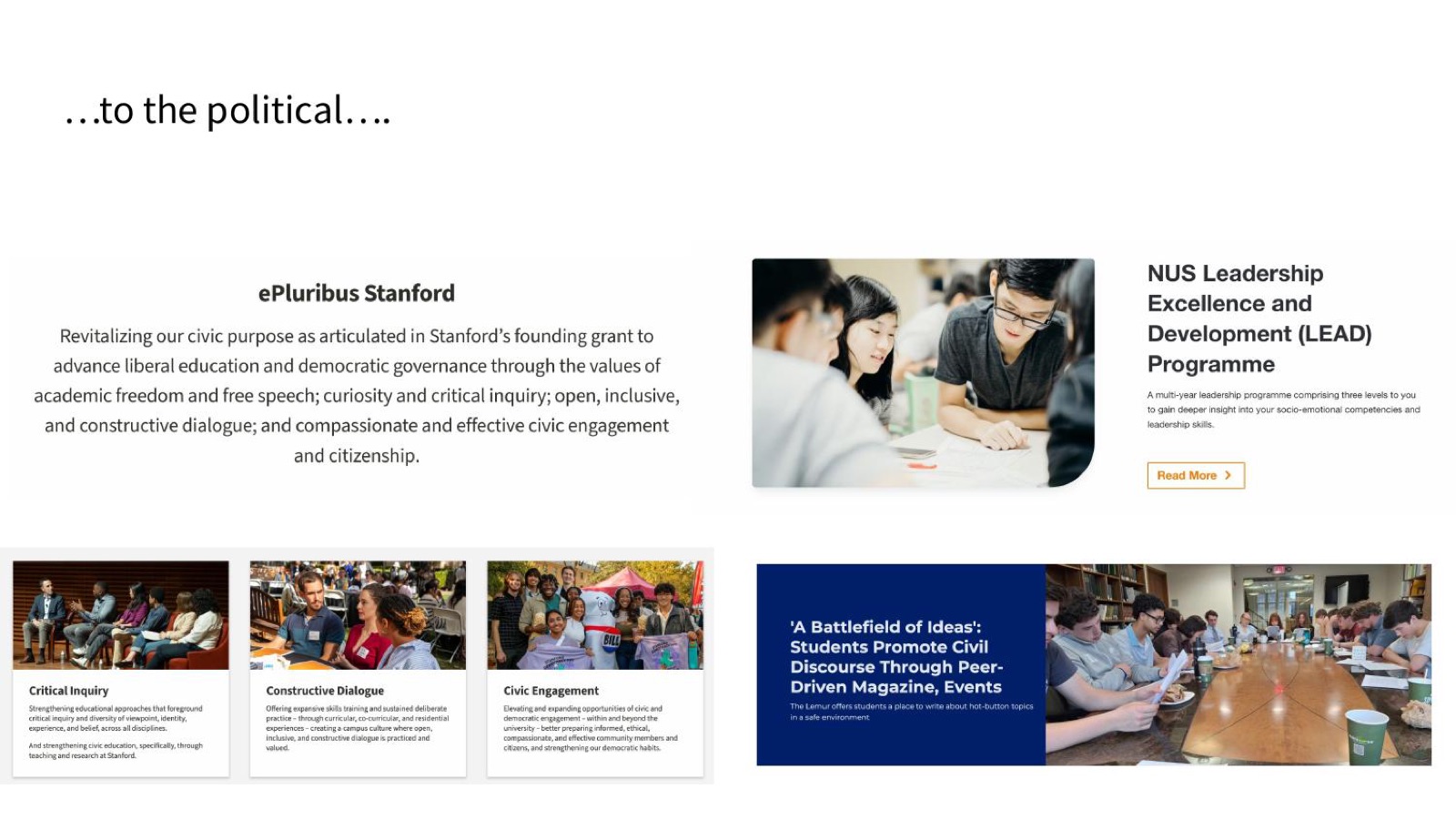
So what are we designing for? What is the role of the technology? Let's take on a challenge like the political discourse question, which is a concern worldwide, I think, with the breakdown of social cohesion and our inability to converse, our inability to connect with people across differences. This is a massive challenge in the US, in Germany, in countries all over the world. Learning communities are the places where societies train and practice these ideas of engaging with people who are different from you. And if we don't create environments that do that, as we reimagine learning online, as we think about scaling it and making it available to millions more people, we'll miss out on this fundamental building block of stable politics, and I think our societies will suffer as a result. The technologists should be focused on this — this is what we should be designing for: communities that help people engage thoughtfully. Like the psychological issues, the divisions we see in societies begin in schools, in colleges and universities. And if we want to heal them, we'll need a more inclusive educational model that invests in community and allows people to practice engagement across differences.
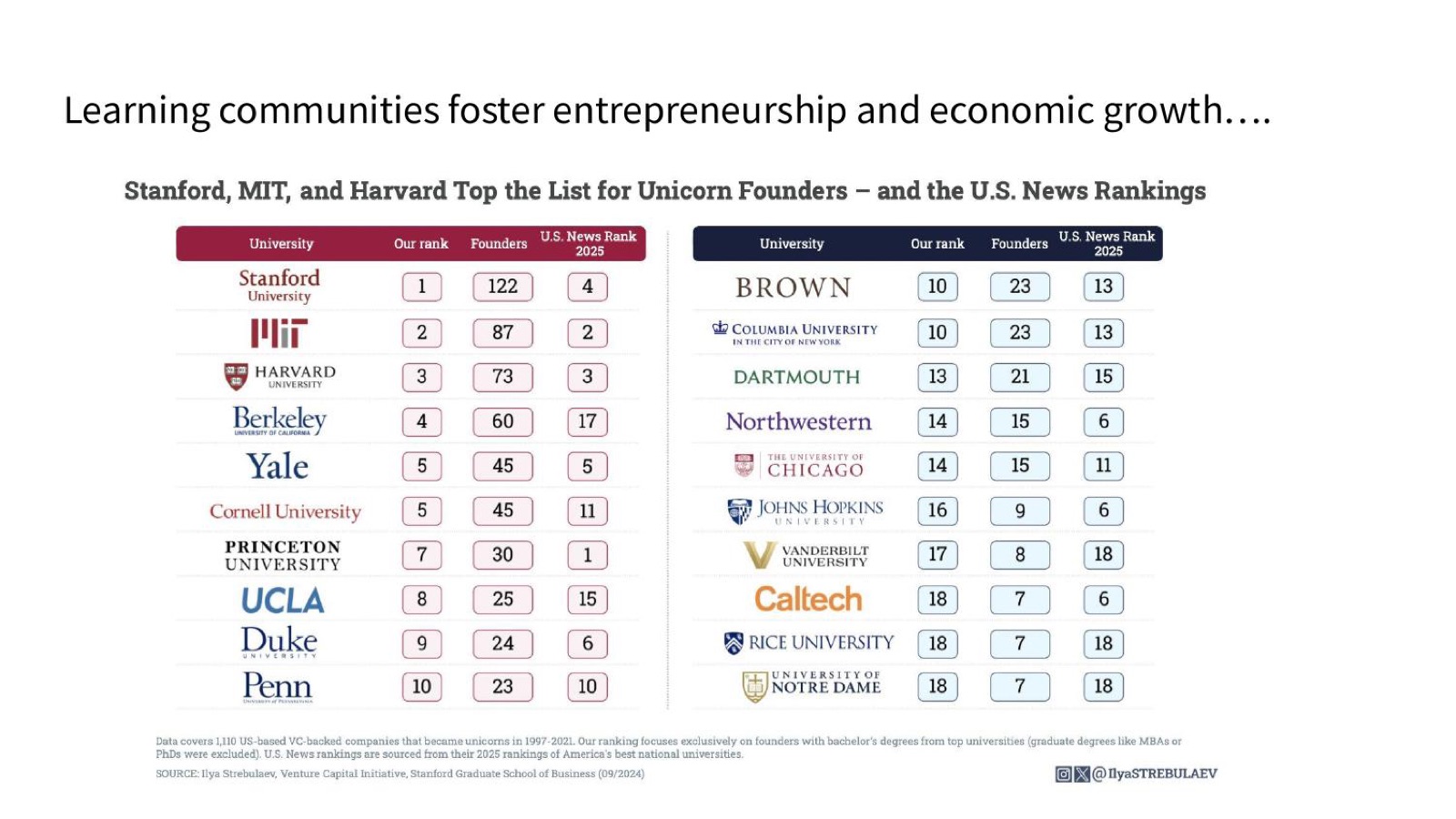
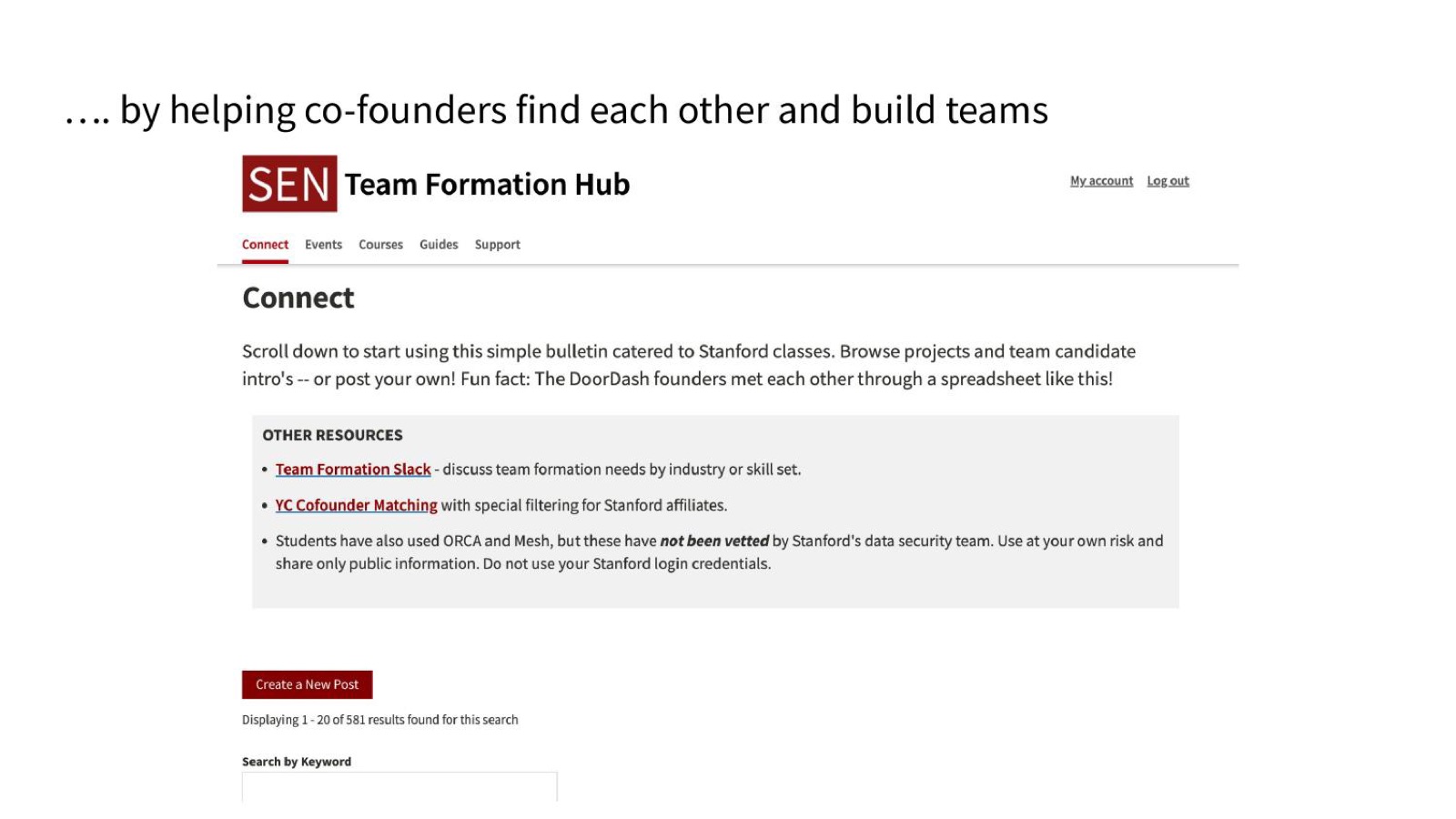
So the psychological, the political, and then there's this economic question. This is about what makes Stanford such a remarkable entrepreneurial institution, which is a question I often get: why do so many unicorn companies — private companies with a billion-dollar valuation — come out of a place like Stanford? The answer is really about social capital. We don't teach any different skills than any other institution teaches. Our content is basically the same, the skills are the same. But we have a model of economic connectedness, of community connectedness, at Stanford. This is called the team formation hub. It's an online platform that helps Stanford student teams come together to found companies. It's an example of this broader pattern I see, where we support complementary teams finding each other — finding skill sets that they don't have. An engineer might not have the business tools; the business student might not have the engineering. You put them together, and then you see an amazing startup come out of that. Sometimes we think of entrepreneurs as individualists, but at least in the Stanford culture, it's quite the contrary. They're actually the most collaborative team players, and their connections are supported by a culture of mutuality, of complementarity, of connected learning. So that's a framework for thinking about what the technology could do, from the psychological to the political to the economic.
Host: Right. For us as educators, it's kind of easy to see the value that these learning communities bring to the classroom. But what you're saying is that the value of learning communities goes way beyond the classroom.
Matthew Rascoff: Exactly. There's one critical role that learning communities play in society that's been studied now quite carefully that I want to zero in on for a minute, and it's this question of social mobility — the economic impact of learning community on the creation of opportunity in the next generation. This is really about the public goods that are created by learning communities. It's not just about the benefits that flow to you as an individual, but how those spread to the rest of society.
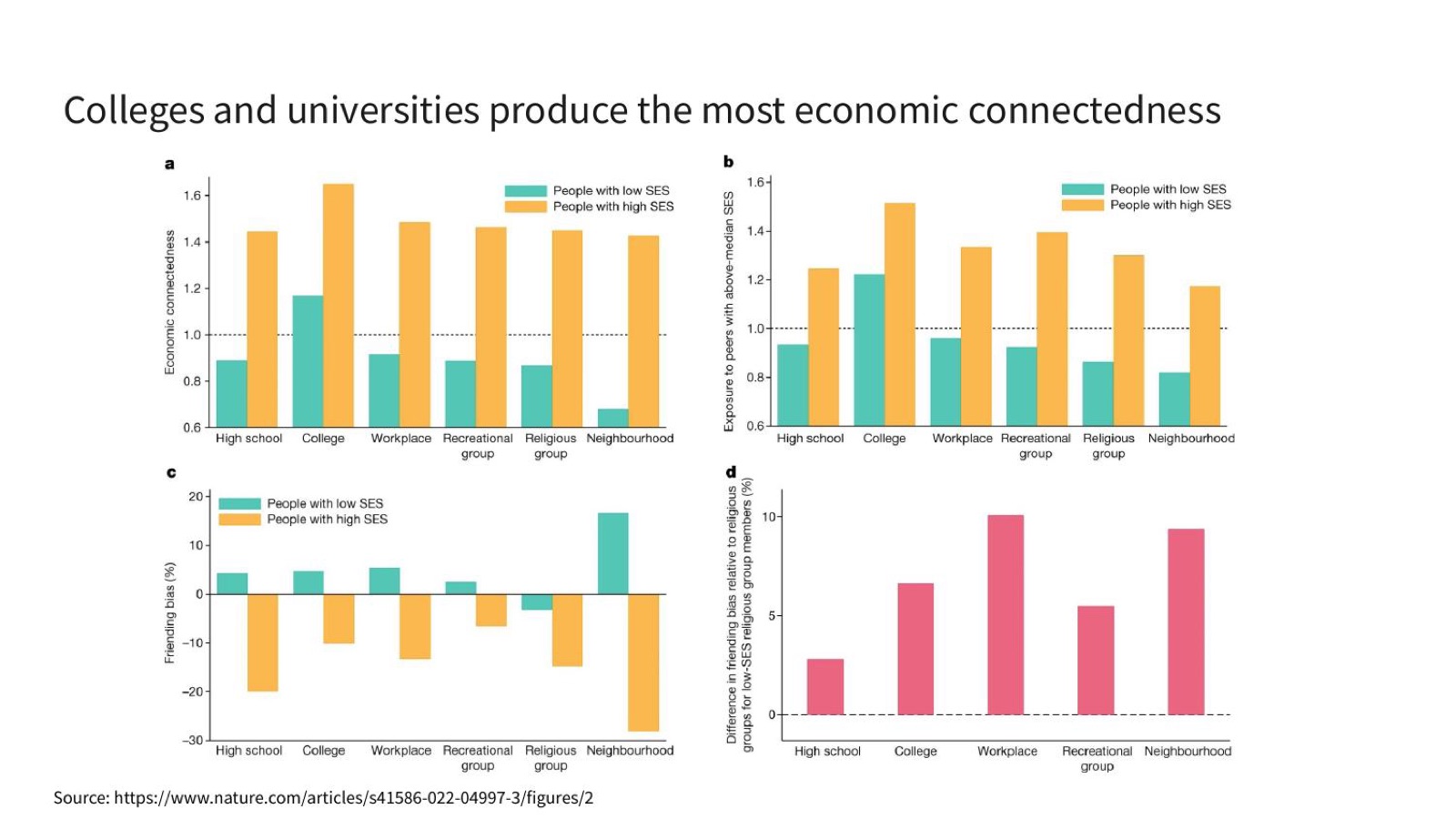
The economist Raj Chetty and his colleagues at Harvard studied the impact of social capital on social mobility, and they found that one very particular form of social capital, which they call economic connectedness, is associated with higher rates of economic mobility. Economic connectedness is the idea that low-income students and wealthier students are able to form friendships across class lines. You can see here on this chart that the top line, economic connectedness, is the primary driver of mobility in the United States. So do low-income students have the opportunity to build relationships with higher-income students and their parents and their families? When you create opportunities to build community like that, you see their opportunities expand — you create them for the next generation.
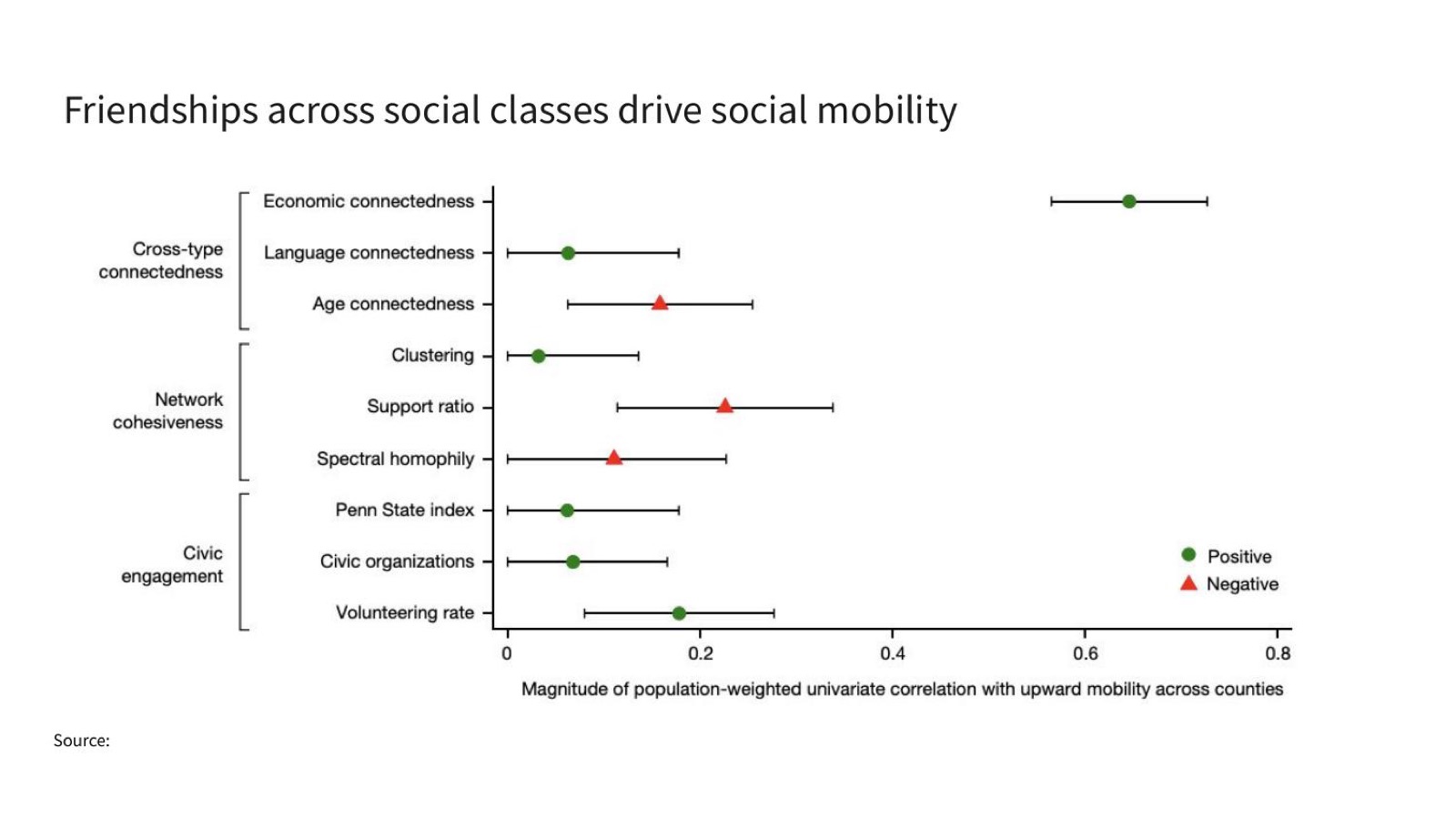
And it turns out that among all the institutions in society that Raj Chetty and his colleagues examined, colleges and universities produce more economic connectedness than any other. So this is about whether our institutions can reverse intergenerational poverty, whether we can create more opportunity, whether we can really build economies. If you look at this chart, they examined high school, college, workplace, recreational groups, religious groups, neighborhoods — and the very highest levels of economic connectedness are produced by colleges and universities.
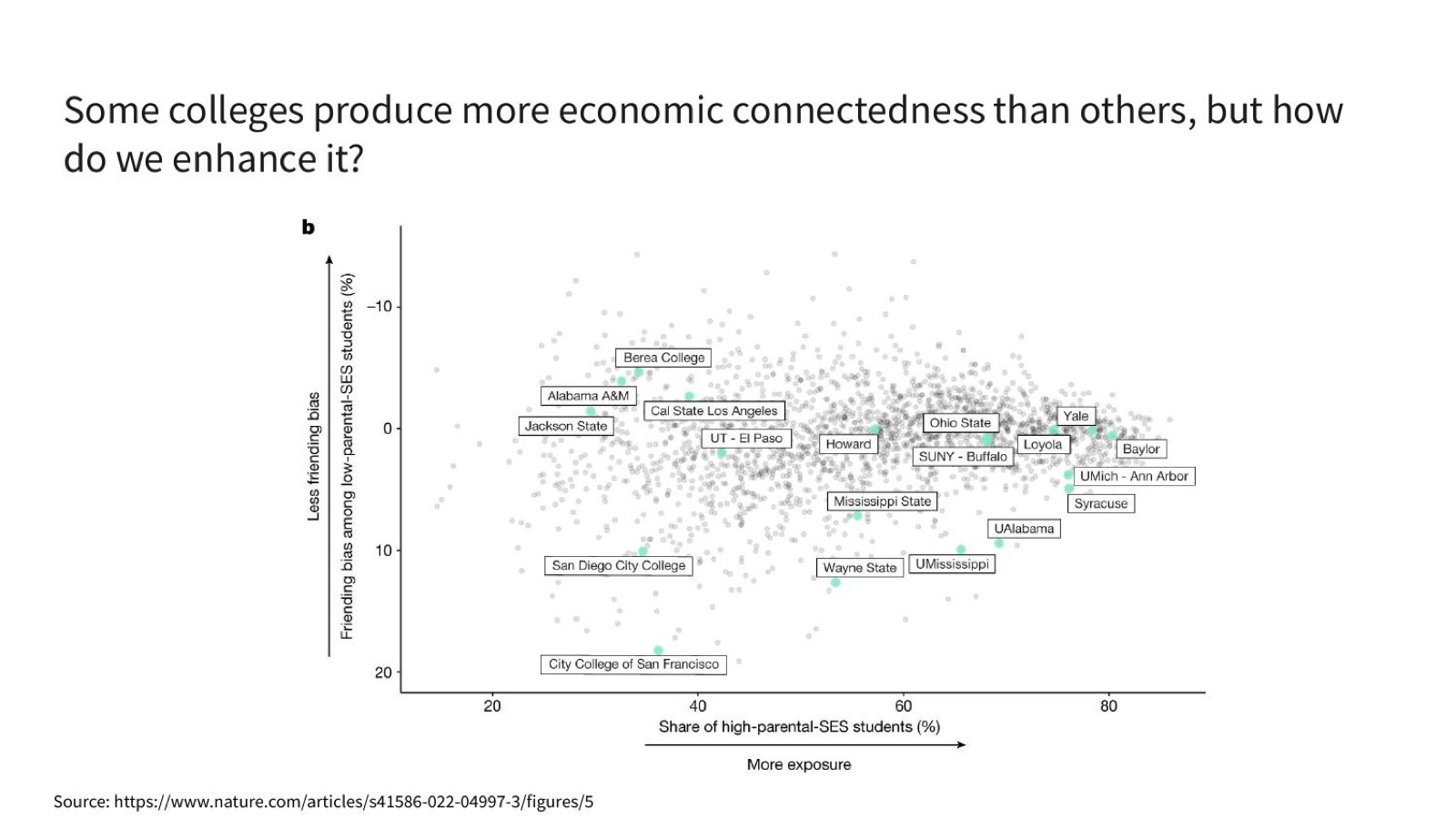
The problem — and this is where we come back to technology — is the huge variation among colleges and universities that Chetty studied. There's a huge spread in their ability to produce economic connectedness. Some do it much better than others. And to me, the big question for the technologists should be: how do we enhance it? If we know it's possible, and we know how important it is, both for individuals and for society — for our psychological well-being, our political well-being, and our economic well-being — how do we produce more of it? That, to me, is the marching orders for the technologists: to work on the really biggest problems in education. This is the one we need to point them at. And I've got some examples to share with you about technologists who are working on this and really making progress on it.
Host: Please do. It would be very unfair to say all of this and not show some examples of how it actually works.
Matthew Rascoff: I'll get there in one second. But just to return to this question about technology framing, I want to offer a framework that might be useful for categorizing these. This comes from Roy Bahat, who is a venture investor, and it's really about thinking about the impact of AI on work generally. I'm going to try to apply it to education here. His framework is: the power loom is on the left. That replaced manual labor, replaced artisan looms in homes. You can think of that as the first stage of technological disruption. In the middle is augmentation — his example is a slide rule or a calculator that maybe allows an accountant to do their job more effectively, but doesn't fundamentally change their profession. But to me, the real excitement comes when we think about new capabilities. The new-capabilities model here is a crane — a crane that enables you, for the first time, to build skyscrapers. With skyscrapers come density, urbanization, public transportation, the knowledge economy.
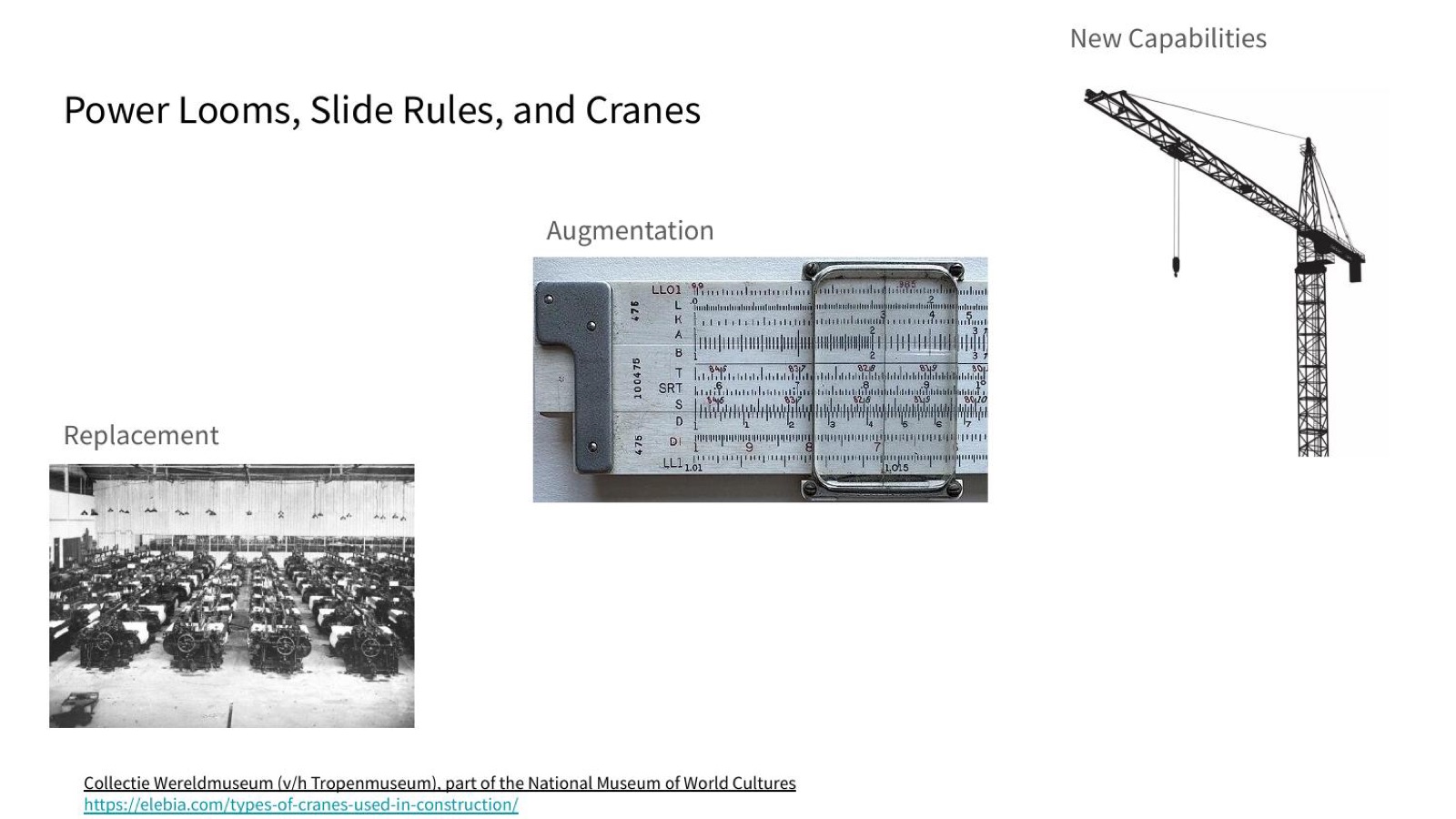
So the question is: what is that crane of educational AI? I think the crane is that ability to scale education that enhances both human capital and social capital — that strengthens skills as well as networks. And I think we now have some examples of new learning technologies that are emerging that build human connectedness online, which has not been possible with an earlier generation of ed tech. To me, that would be truly the treatment for Baumol's cost disease, where I started. Let me give you a couple of examples, just to illustrate the point. So let me pull up one of these and see if we can get this video working.
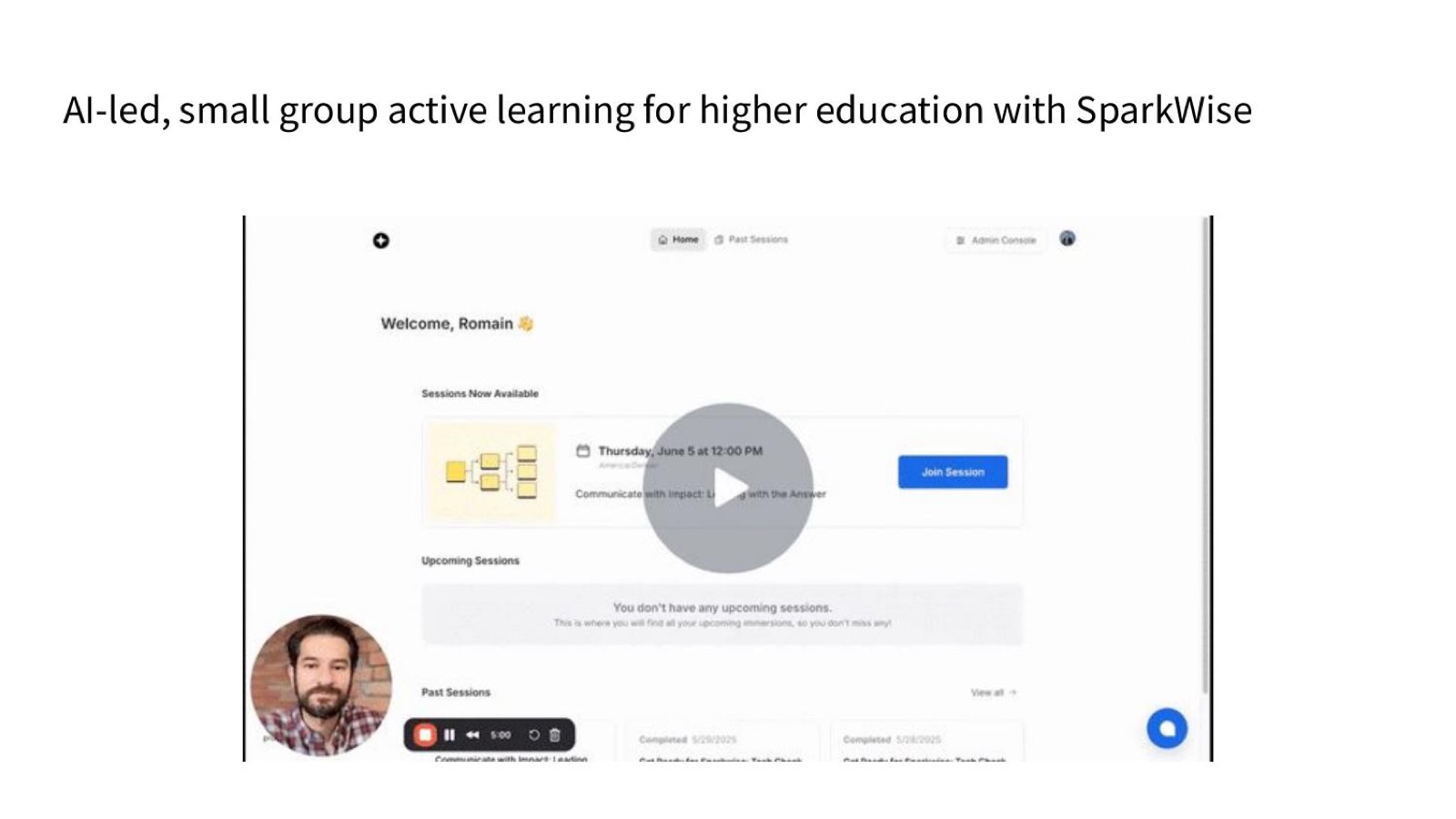
[Video — Sparkwise] The learning platform, and what's unique about it, is that it lets people run live small-group training that doesn't require an instructor to be present to drive the group. Instead, the group is guided by our platform through a series of active and discussion prompts so that they have a fruitful experience. So let me quickly show you how this works. Everything happens in the browser. There's no app to download or install. It's just like scheduling a meeting — people will have an invite on their calendar, and when it's time to join a session, they'll simply log in to the platform and join the session. At the beginning, you may get a quick overview about the topic and why we've been talking about this. You see the video is very short. Our goal is not to lecture people — we know people don't like watching these endless videos or clicking through slides on their own. So instead, we're going to very quickly get them together on video with their group. You would imagine anywhere between two and five people work together on the platform, each on their laptop, going through a series of activities together. You can actually have hundreds of people doing the session at the same time; they'll just get added into smaller groups as they join. I'm just going to show you a few of the activities that we have. We have dozens of different types of activities, to give you a sense of the kinds of interactions and how we keep the discussion flowing and moving. You see there's a timer on each step — it really helps people stay on track and make sure they finish by the hour. They can also see a timeline of all the steps they're going to go through together. This one is a little interactive activity where there's a shared whiteboard, and everyone would be able to collaborate here — pick a sticky and start typing, create more stickies if they want to. And then we're going to debrief this activity and introduce the actual concept or framework that we want them to remember.
Matthew Rascoff: I'll stop there. This company is called Sparkwise. It's for adult learners, and it's helping them work together in this small group, and the AI is there to facilitate it. So it's running a kind of sticky exercise that you might typically have a professional facilitator run for you in a design session, but it's all enabled by this technology. They have their video on, working together, and there's a kind of machine orchestration that's allowing them to work together.
Let me give one other example. I've got a few of these, actually. This is a company called Protopia. It's about student-to-alumni connection, helping students find jobs using the alumni network of their school. It's an AI that plugs them into these networks based on shared interest between the student who's looking for a job and an alumnus who may have expertise in an area and may be offering a job or willing to support mentorship. So in this case, it's really about extending learning community from a college or university to its alumni all over the world. I've got another little video that I'll play.
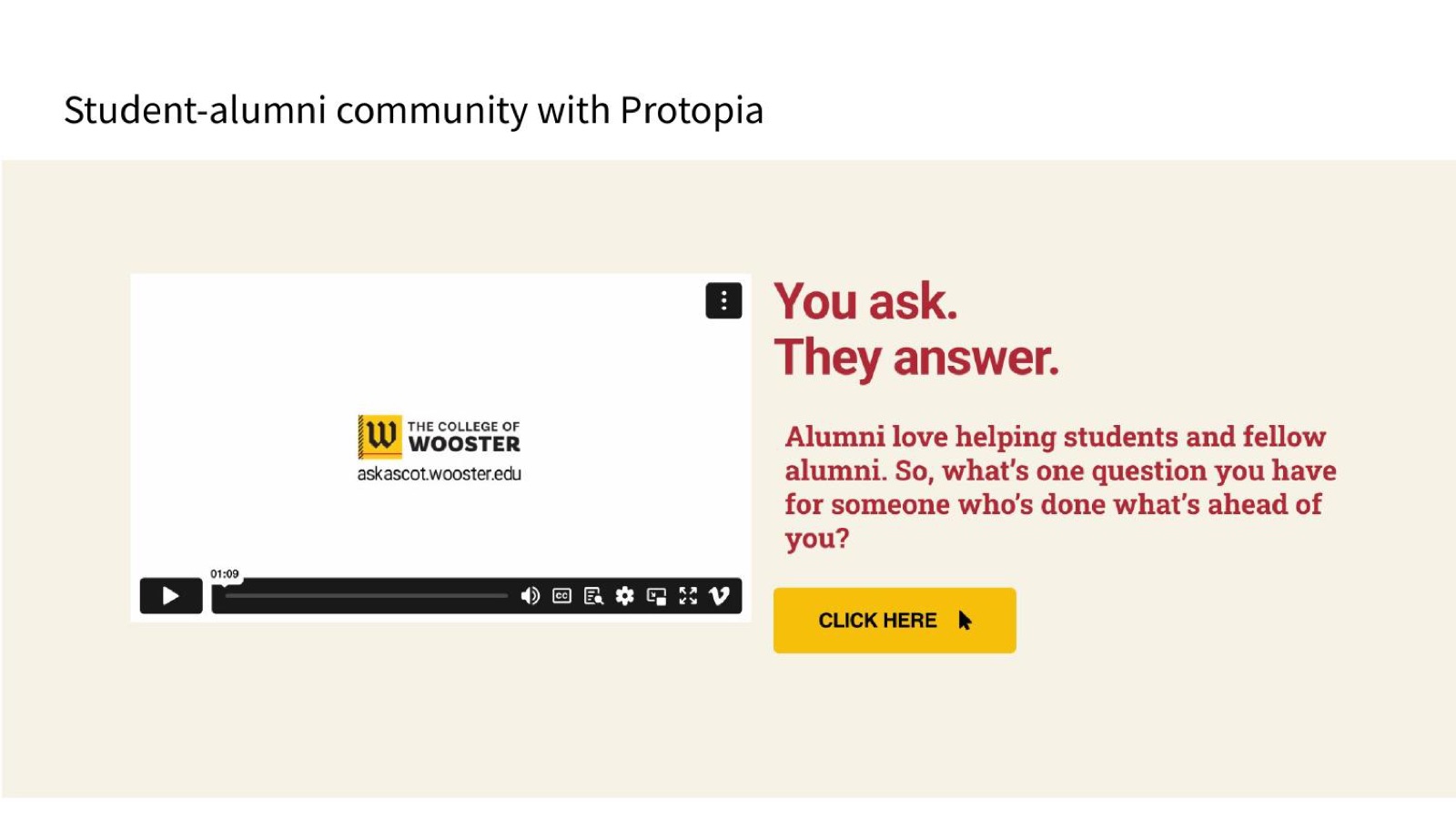
[Video — "Ask a Scot," The College of Wooster] Do you know you are already part of a community of thousands of Scots committed to your success? And you don't have to wait until you graduate to reach out. With Ask a Scot, it has never been easier to get help from the community right now. Alumni can help you figure out the next steps in your College of Wooster journey, give you insights into a future career, or help you get your foot in the door at your dream company. Sounds great, right? But the first step is finding them, and that can be a frustrating process. That's where Ask a Scot can help. You fill out a short online form with your name, your email, and your burning question. We'll send it out to our online community of experts and make a match. Within a few days, a fellow Scot will email you directly. It's as simple as that. You'll get direct, one-to-one communication with a Wooster alum who has paved the way for Scots just like you. You have a question? The College of Wooster alumni have answers. Find a Scot who can guide you on your journey.
Matthew Rascoff: So this is obviously branded for the College of Wooster, a single institution. They've licensed this tool from Protopia and enabled it for their alumni network. To me, it's really about extending the learning community from a college to its alumni all over the world. It's not a learning platform per se, but it's an online tool that takes a residential college and allows it to project its connections wherever its students might want to move or get jobs or find opportunities. That, to me, is an enabler of the kinds of connections that extend community beyond the physical borders of the school. The company is called Protopia, and it's really invested in building out the social capital model of learning and extending it, both for the benefit of the student and for the benefit of alumni.
Here's one that I find quite inspiring, especially in a global context. I don't know if you've seen this demo yet, but this is a new product from Google that's doing live simultaneous translation. When we're talking across cultural borders, I hope you'll see the value of this. So have a look.
[Video — Google live speech translation] Hi, Camilla. Let me turn on speech translation. It's nice to finally talk to you. You're going to have a lot of fun, and I think you're going to love visiting the city. The house is in a very nice neighborhood and overlooks the mountains. — That sounds wonderful.
Matthew Rascoff: So they're speaking in their native language, and this AI is live-translating for the speaker in the other language, and doing it with a very, very minimal amount of latency. It's like the United Nations, with the earpiece in your ear — but imagine enabling that for everybody. This is obviously a commercial transaction that they're doing here, but imagine a seminar where students come from many different linguistic backgrounds but have the ability to communicate regardless of a common language. This kind of gives them a common language. There's now an institution in Germany, Tomorrow University, that's building out a kind of seminar model that works across all the European languages, that brings people together in this way. To me, that's hugely impactful. It's hugely exciting, and it allows us to think about connectedness in a different way that might be global. I have an example from Stanford, if you want to see more, or should I stop there?
Host: I think we're good with these examples. Thank you. But this is a keynote presentation, and I think there's no keynote presentation these days without me asking: what do you find to be most exciting about the opportunities with AI for education?
Matthew Rascoff: I really think it's this model of AI that brings people together in a more effective way. You'll notice that all of these technologies are based on AIs, but none of them are based on ChatGPT. None of them are chat-based AIs. They're not trying to create an individualized, personalized model. They're all trying to create a community model, and the AI is there in this behind-the-scenes way that allows people to connect more effectively with other humans. To me, that's a fundamental breakthrough. It's a fundamental difference from the way most people are approaching the AI question. Most of them are approaching it in that replacement or augmentation way, where it's about enhancing my own ability — I want to get the answer to this question, I want a tutor, I want personalized learning as one framing of this. But to me, the most impactful AIs are going to be the ones that enable people to learn more effectively in these models, to connect with one another more effectively, to understand each other's needs, to use the principles of active learning — which are so well established by learning science — but apply them at scale, apply them in a global context, apply them more systematically. It's a kind of model for machine orchestration of human collaboration, and that, to me, is a really big breakthrough.
In some ways, it's a more modest role for the AI. It's not trying to have the answer to your question. But in other ways, it's actually a very ambitious role — possibly even more ambitious, if you think about what has driven human progress over time. It's really about human collaboration, about our ability to work together in ever-larger groups. This is the AI where you could imagine millions of people working together in relatively small groups that feel intimate, that feel connected for them, that grow their connectedness. I call this concept fractal scale — meaning you can get very big, but for any one individual participant in a group, it feels small, it feels intimate. You can add more and more small groups, as many as you wish, but each of those feels like you're part of something like a Harkness table with ten people around it, learning together. And the AI is there to preserve that connectedness, to preserve that intimacy, to allow the humans to be human together. That's what I see as the potential in this space.
Host: And do you have an example of how that actually works in a real course?
Matthew Rascoff: This is from Stanford. It's called Code in Place. It's an online programming course based on CS106A, one of the most popular courses at Stanford and a gateway to the CS major. We have tens of thousands of students around the world who've taken Code in Place over the past five years, and they do so in sections of ten students led by what's called a section leader. So we can recruit and support thousands of these volunteer section leaders among our alumni, and offer this course to tens of thousands of learners every spring. It's a different approach to scale that really balances the benefits of a human teacher and a cohort with the benefits of geographic and temporal flexibility.
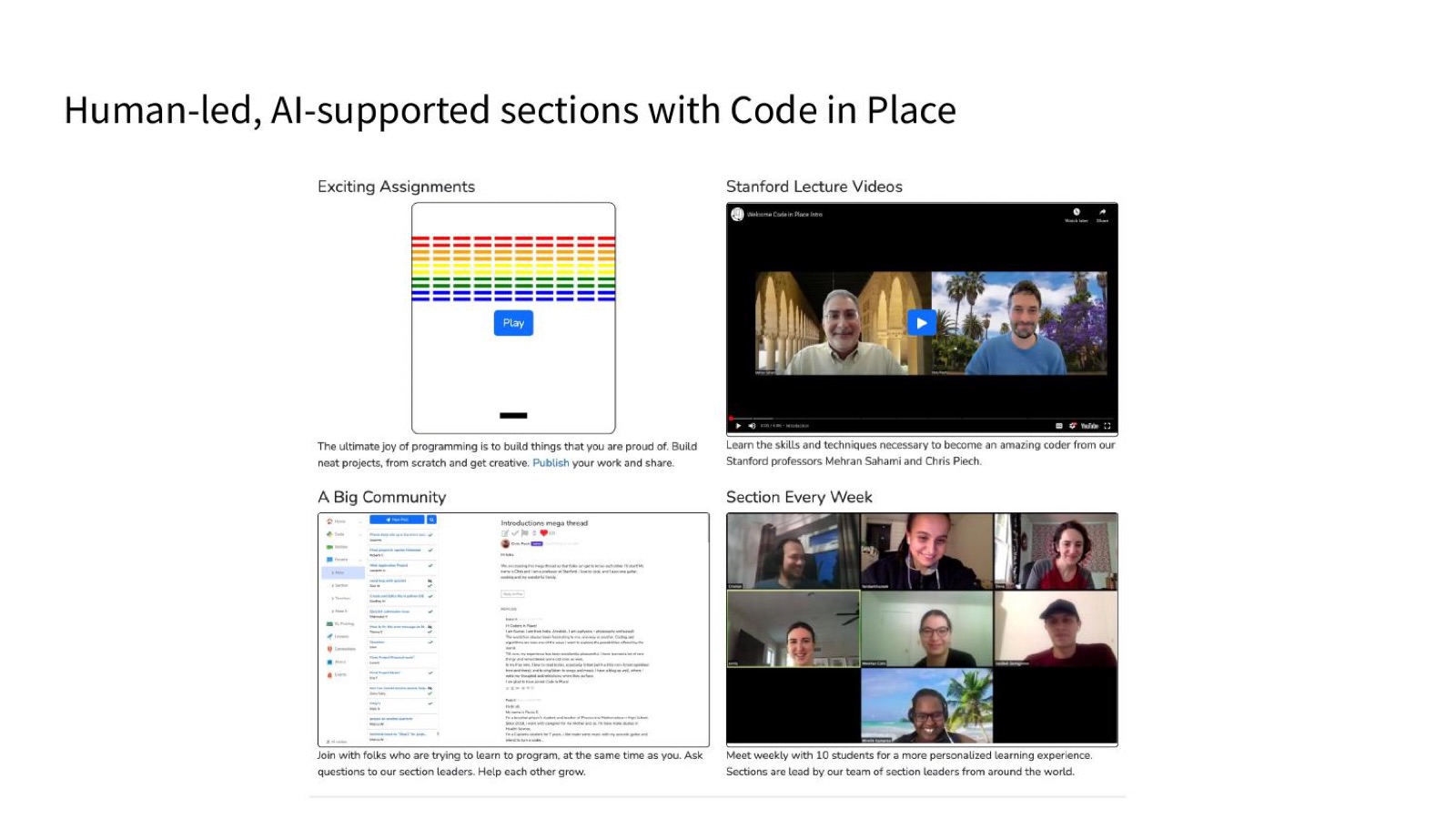
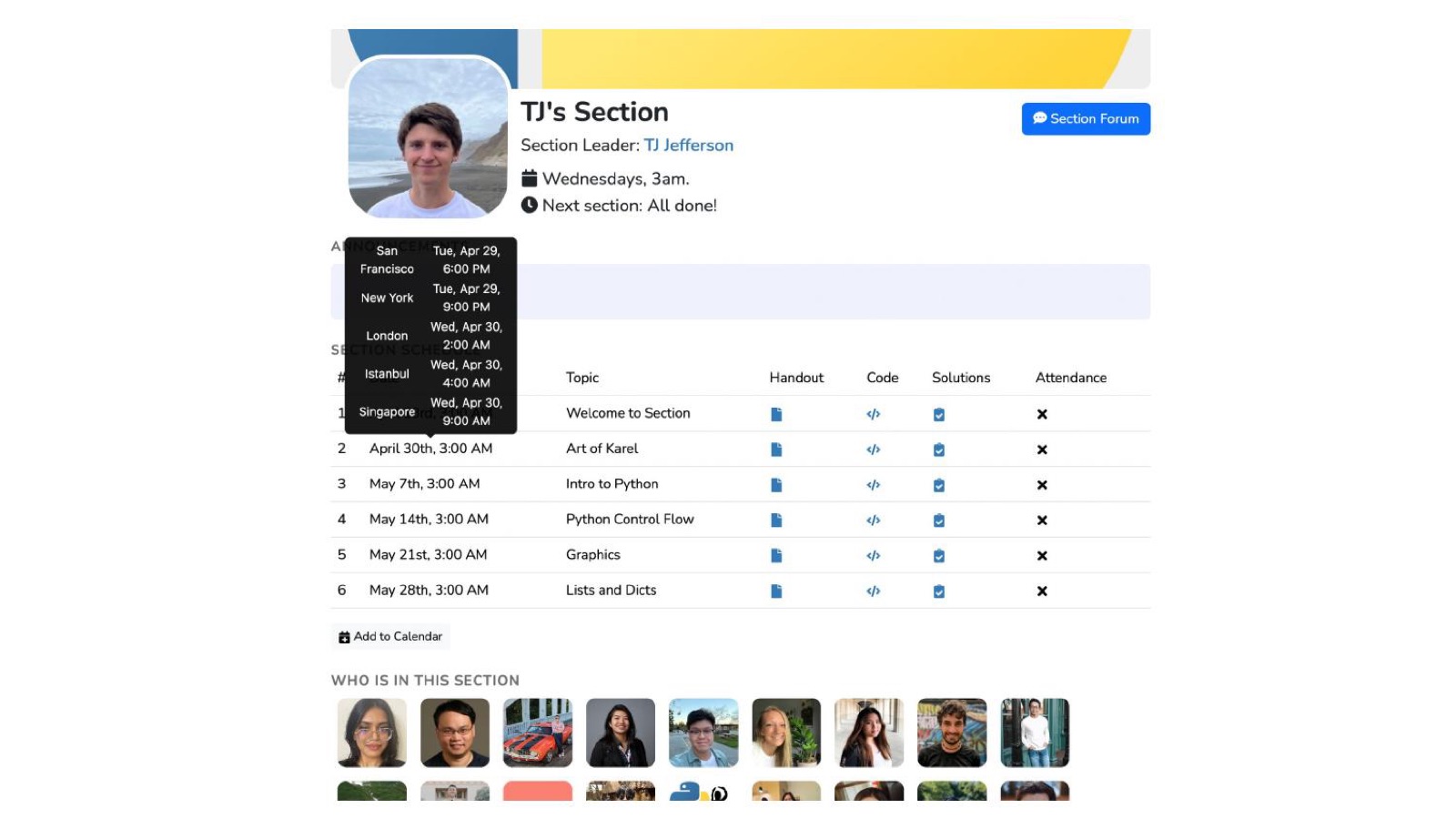
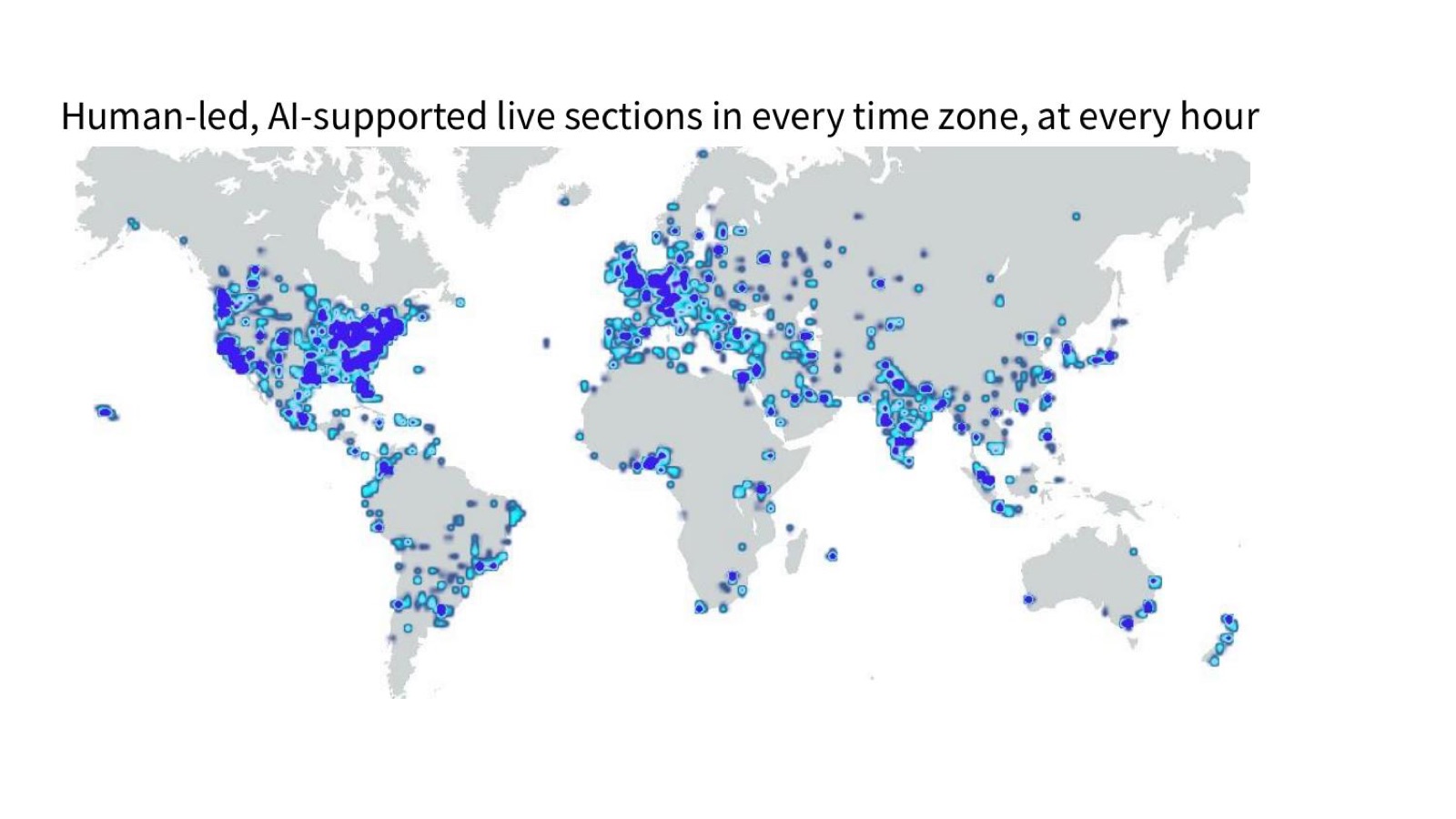
I logged in to Code in Place — take a look at the time zones. I logged in to this section from Germany, where it was 3 a.m. But it's the 6 p.m. slot in San Francisco, and a pretty reasonable 9 a.m. slot in Singapore the next day. So you can have learners coming together, doing this course after working hours in California, learning together with those who are doing it during business hours in Singapore. There are sections of Code in Place offered every single hour of the day, from Wednesday to Friday. I call this the massive multiplayer effect. It combines the flexibility of asynchronous learning — you can do it at any time you want to — with the human connectedness of synchronous learning. If you think of World of Warcraft, you can log in at any time of the day and play with other people. We haven't had models of online learning that have that, where you can log in at any time on your schedule and feel like you're part of a community. That, to me, is what's most exciting about this kind of model of learning: when you have enough scale, when you have a minimum efficient scale, you get these worldwide effects. You can see the result — we have learners participating from all over the world. I see a hotspot in Singapore, actually, over here. And it's hugely exciting to think about a globally connected learning community, maybe even enabled by live simultaneous translation, that allows people to log in wherever they are, on their own time, with the flexibility they need, and still have an intimate, connected experience of helping somebody else, of being helped by somebody else, of working across cultural differences and political differences. That's really what's so impactful about this space.
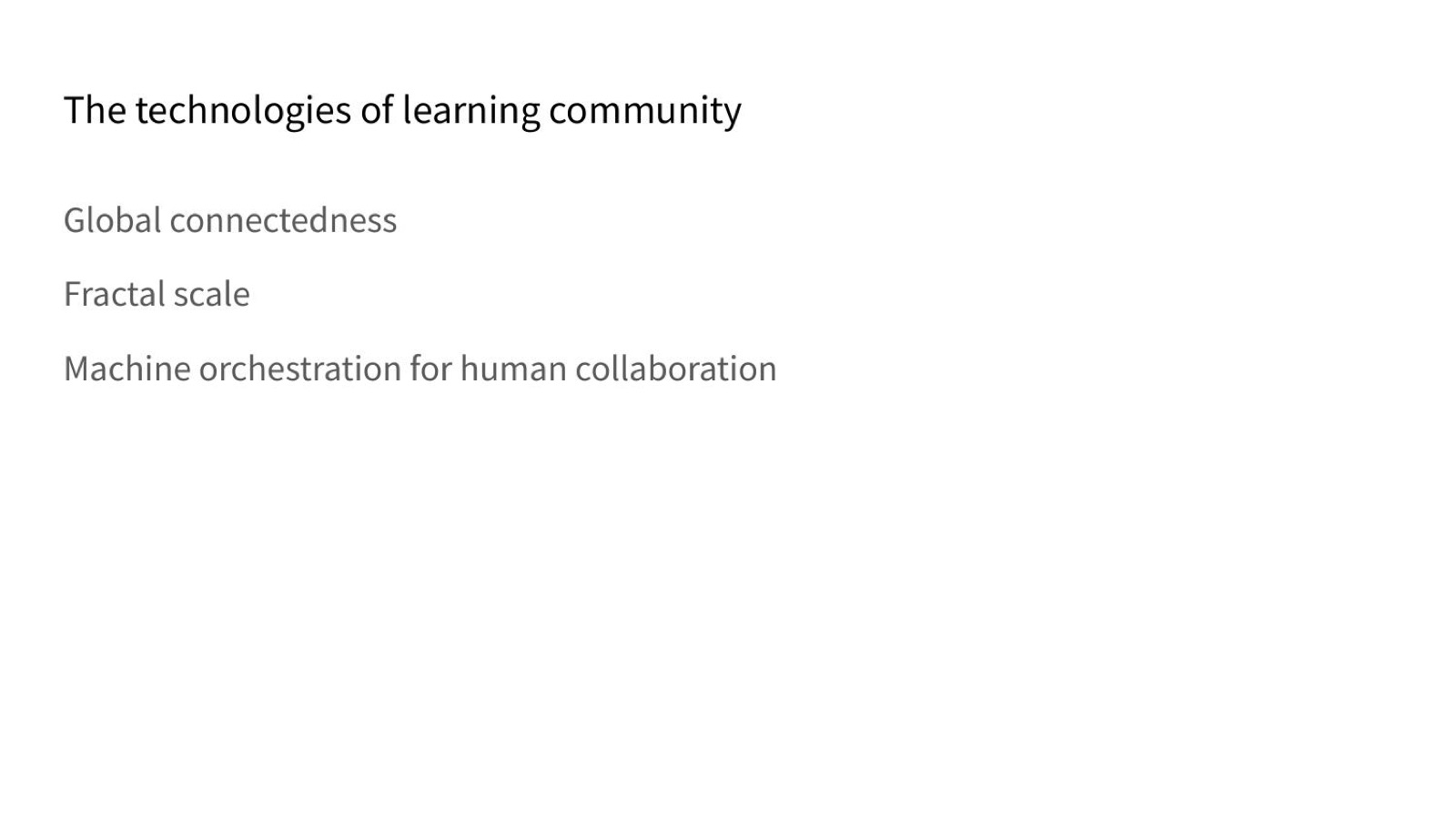
If you're bringing this together into a set of principles, across all these different models from education technology companies and the Code in Place project, I see three things emerging. The first is this idea of global connectedness — that we could really learn more based on our time zones than based on our countries. Time zones, in some ways, become more important than borders. What's convenient in San Francisco might also be convenient in Singapore, and that's going to be the way we design these kinds of at-scale learning experiences. The second is fractal scale — the idea that we can get big without feeling big, that we can get big and still feel small. Many sections, but still sections. The section is really the unit of learning, and they scale up, as many as you need. And the third is this concept of machine orchestration for human collaboration. That's the role of the AI in this space — it allows people to connect with one another. I think it helps us overcome this bias that we have against scale. We usually think that bigger must somehow mean worse, but I don't think that's going to be true in the AI-enabled, human-connected education world. I think we'll actually get improvement with this kind of AI. We'll see network effects, as we have with Code in Place, which means the experience gets better as more people participate. So to me, human-connected AI has only just begun to come into education, but I hope these examples help you start to imagine the possibilities of designing learning in this way.
Host: Beautiful. Thank you so much for that. I think we have time for one or two questions from the audience. While we make time to put them on Pigeonhole, maybe I can start off with one practical question. Since we recognize the value of the learning community, what are perhaps small things that people can do in their own environment — that instructors can do within their own small environment, or that institutions can do — to help build those important elements of community?
Matthew Rascoff: The technology can seem quite intimidating, but none of these products are particularly expensive, and they're not unreachable. For those who have the ability to build, I think there's going to be a kind of flowering of different open-source models that allow different kinds of interactions — the same kind of diversity that you saw in the different face-to-face learning communities, like the Harkness table, the Deep Springs model, and all of those. I hope we see that kind of diversity coming into the digital learning world. I don't think we yet have that kind of pluralism, but that's what I hope digital learning designers, instructional designers, and faculty are able to see. Let's create the models that we believe in. That diversity of different approaches to community is a real strength.
So if you believe in think-pair-share, and you believe in that kind of model we talked about before, that is very doable, even in an online environment, with the technologies that we're using right here, right now. You can start experimenting with that and iterating on it without having advanced tech. That's the move that we make toward social capital, toward human connectedness. It's really about values — it's a kind of principled move — and the implementation of it is actually not that complicated. These are various technologies, all of which you can use and license. Code in Place is fully open source — the whole platform is available for anybody to use. But you can get started on this just with the toolset that you have at your disposal now.
Host: Beautiful. Thank you. I think the question that is currently getting the most votes is, in a way, a summary of things that you mentioned, so perhaps we can round up with that. It's saying that the common thread in the traditional models of community is closed, limited access to specific groups of people. How do we balance community and scalability and wide access?
Matthew Rascoff: It's a really important question, and I think that's part of the challenge. Is Deep Springs only effective because it's such a small community? The Code in Place argument is that it doesn't actually have to be elitist in order to be connected and intimate. Code in Place last spring was 20,000 students. So we had 2,000 sections, 20,000 students, led by 2,000 section leaders. And the completion rates are like ten times higher than what you might see in a MOOC. The net promoter scores were like 99. So you can actually get really great outcomes if you design for these principles, if you design for this pedagogy, but make it available to everybody.
My argument is that it was not a fundamental fact of these earlier communities that they had to be closed. That was actually just an accident — a limitation of the ten people around the table. If Exeter could build a thousand Harkness tables, then we should do that. And that's possible. You might see many of the same benefits of having the face-to-face version of that available if you made a thousand of them, democratized and available worldwide. To me, that's what we should be focused on. That's what Code in Place is all about. And that's the mandate for us as educators who don't believe in closing access to our system. We want to make it available to as many people as possible. So that, to me, is the frontier that we should be advancing — moving this idea of openness and access and widening opportunity to many more people, for those benefits of social mobility, of economic opportunity, of entrepreneurship. The psychological benefits, the political benefits — that's really for everyone. If we want to think of our institutions as producing these public goods, I think it's really incumbent on us to move away from that closed, private model and make those benefits available to everybody. And we'll all benefit as a result — not just the students who come into your course, but whole societies, one generation later.
Host: Beautiful. I'd like to invite everyone: Code in Place — look it up, see how 20,000 people can study together in small groups and feel like they're part of a community. Thank you so much, Matthew. That's all the time we have for today. I really look forward to an opportunity for you to be here in person in the future.
Matthew Rascoff: Thank you so much. It was a pleasure to interact with you, and I look forward to being there in future.
Host: Thank you, Mr. Rascoff. And of course, thank you to our moderator for that lovely moderation session as well.